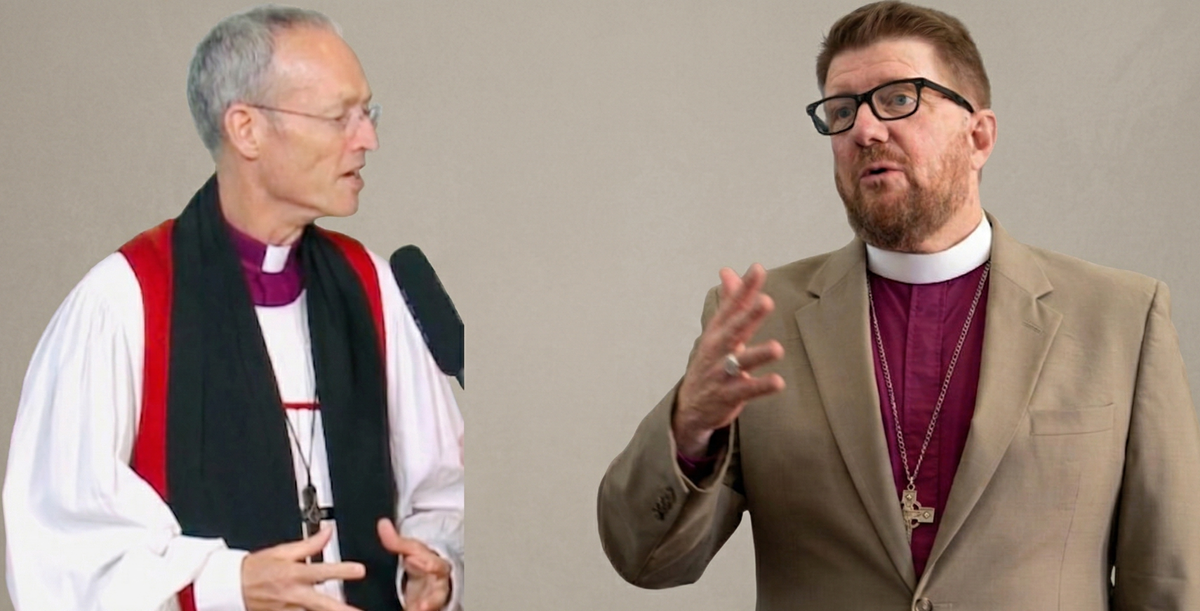
The Anglican Church in North America (ACNA) and the Anglican Diocese of South Carolina (ADOSC) have traded letters in an ongoing quest to figure out why the trial of Bishop Ruch was botched so badly. The ADOSC has raised serious concerns about the integrity of the judicial process, while the Province has moved to initiate an independent review of its administrative actions.
2025
- August 8: The ADOSC issues an initial update to its clergy regarding the ongoing trial proceedings of Bishop Stewart Ruch III.
- September 15: The ADOSC sends a formal letter to the ACNA Executive Committee expressing concern over “troubling developments” and “confusion and disruption” resulting from the trial. This letter specifically requests an investigation into the Provincial Office to begin no later than 60 days after the trial’s conclusion.
2026
- January: The ACNA Executive Committee appoints a Subcommittee to oversee a review of the Provincial Office’s administrative role during the Ruch proceedings.
- February 20: Bishop Charles Edgar and the ADOSC Standing Committee issue a formal public letter to the Executive Committee. They argue that the Court’s verdict lacked credibility and call for an “urgent, independent, third-party investigation” into the Provincial Office to ensure the long-term health of the Province.
- February 26: ACNA replies offering that the ADOSC “receive a delegation from us.”
- March 20: The ACNA Executive Committee issues a formal response. They announce that a secular investigative firm has been engaged to conduct the review and clarify that the Court for the Trial of a Bishop operates as an independent body.
- April 21 (Upcoming): The Executive Committee has invited Bishop Edgar to attend their regularly scheduled monthly meeting (3:30 pm ET) to discuss these matters further.
The letters follow:
Letter from ADOSC
20 February 2026
Matthew 5:15-16
Nor do people light a lamp and put it under a basket, but on a stand, and it gives light to all in the house. In the same way, let your light shine before others, so that they may see your good works and give glory to your Father who is in heaven.
To the Members of the Executive Committee of the Anglican Church in North America,
Grace and Peace to you from God our Father and the Lord Jesus Christ.
On September 15, 2025, we wrote to you regarding the troubling developments surrounding the ecclesiastical trial of Bishop Stewart Ruch and the confusion and disruption that followed.
That letter included our August 8, 2025 correspondence to the clergy of our Diocese. Our sincere hope was that the conclusion of the trial and the findings of the court would address these concerns. Unfortunately, that has not happened. We write now with even greater urgency, convinced that the “independent, third party investigation into the Provincial Office’s actions during the course of the trial, to begin no later than 60 days after the conclusion of the trial process” that we called for is essential to the long-term health of both our Diocese and the Province.
Let us be clear: we understand that the charges against Bishop Ruch will not be retried. We are not seeking an appeal. This case is concluded. Where it has left us, though, must be acknowledged. At present, our shared life is marked both by diminished trust as well as by heightened suspicion of moral failure at the highest levels of leadership.
We in the Anglican Diocese of South Carolina are no closer to reconciling the apparent contradictions between the former Provincial Prosecutors’ resignation letters and the court’s orders than we were when those resignations occurred. This remains true despite the court’s August 12 public statement that in addition to the order, “The Court will also address…all questions related to the fairness and integrity of its proceedings.” Instead, the extraordinary events surrounding the trial have gone largely unaddressed.
The former prosecutors allege that the Archbishop’s office granted permission for a member of the trial court to access the prosecution’s files without their knowledge; that the subject of those files had already been ruled to be excluded from the record by prior court order; and that those files became the basis for improper questioning during the trial. Until the air is cleared regarding these allegations, suspicion remains. When facts are inaccessible, repentance, forgiveness, and grace are hindered, and our communion in the Body of Christ suffers as a result.
The court chose to hold the proceedings in private. It appears the court chose not to employ a court reporter. The court has thus far chosen not to release the record. We assume these decisions were made in good faith although the confidentiality of the proceedings appears inconsistent with court rules and norms, as discussed below. Yet taken together they build a wall around the truth, leaving those outside with only the final ruling of December 16, 2025 to understand what occurred.
Unfortunately that ruling has intensified our concerns instead of ameliorating them, and reinforced the urgency of our original request. The order neither fully exonerates Bishop Ruch nor adequately addresses the serious questions it raises. Its treatment of the Province raises further concerns about character, competency, and procedure among some of our highest-ranking and longest-serving bishops. At a moment when our Province most needs reasons for trust, we instead find ourselves with more reason to doubt.
Both can be addressed by the public release of facts. If there is a moral failure within the ACNA, it must be known so it can be addressed. If there is not, then suspicion must be dispelled through transparency and open process. Whether or not you agree that trust has been lost, demonstrated trustworthiness remains the only way for trust to increase. With no appeal pending, the court has little to gain and no evident reason to maintain strict confidentiality over these proceedings. The ruling itself rests on the evidence and cannot be threatened by that evidence. It is standard for court records to become public once proceedings conclude.
Likewise, any third-party investigation will only deepen concern unless its engagement letter, scope, and full findings are made publicly available. Anything less will only reinforce the very confusion and scandal the court identified as damaging to the ACNA. We cannot afford as a Province to let obscurity flourish where clarity is needed. The forthcoming trials of Bishop Jones and Archbishop Wood will come before this same court and follow these same procedures. It is therefore vital that we at every level of the ACNA learn as much as possible, and quickly, from what has already occurred so future proceedings may be received as just and credible. Let us commit now to avoiding even the appearance of impropriety, in what has happened and in what is yet to come.
Our goal is simple: to restore trust and eliminate suspicion. We trust this is your goal as well. To that end, we commit ourselves to making no predetermined judgments, and to ensuring that those entrusted with responsibility and jurisdiction act openly and faithfully. We likewise ask that no assumptions be made about us or anyone else seeking clarity. Let the record speak for itself.
The clergy of our Diocese are aware that we called for a third-party investigation to begin within 60 days of the trial’s conclusion, by February 16, 2026. They are eager to see tangible steps toward restored trust and health within the Province. They also desire to know how we are contributing to that work, and therefore we will be sharing the full contents of this letter with them in 30 days (March 23, 2026), with permission to disseminate further at their discretion. We welcome your response to be included in that communication, so they may be assured of all efforts being made towards our shared goal of increased trust and diminished suspicion.
In addition to acknowledging receipt of this letter, we respectfully request your response to the following requests, and if any of them cannot be met, we ask for a written explanation as to why:
- We request that the important standard of avoiding the appearance of impropriety be held up and maintained among the provincial staff in all pending and future proceedings. As discussed above, serious questions remain about why the Provincial Chancellor and the office of the Archbishop allowed a court member in the Ruch trial to have access to electronic files of the prosecution team without the prosecutor’s knowledge or Lingering questions about this highly unusual action have engendered mistrust throughout the Province. The recusal of those involved in this concerning incident from future disciplinary proceedings, particularly those involving Archbishop Wood, will help restore trust in the Province.
- In a way that only protects identities of abuse victims or victims advocates, we request the release of a complete transcript of the trial and all pretrial proceedings – the trial video, or the unedited, captured audio from the trial video, or an unedited transcript from the captured audio of the trial video.
- We request all motions and court rulings, including pretrial rulings, be released along with the release of all three pretrial investigations.
- We request the identity of the person/firm that will be conducting the investigation along with the engagement letter defining the investigation’s scope.
- We request that the results of the investigation be made public with appropriate confidentiality for the protection of victims. There should be no reason to attach the attorney client or work product privileges to the report. The trial has been completed and this investigation should be conducted not in anticipation of future litigation, but to help the Province learn from past experiences and to restore trust among all within the Province.
- We offer our 2026 Diocesan pledge to the Province to be used to fund this investigation so that no financial obstacle will prevent it moving forward.
In our call for a third party investigation, we further ask that investigators review facts and publicly respond to the following questions of any reasonable reader that remain based on the limited information that is available. If valid questions like these exist, no one in our Province is served well by leaving them unasked, unexamined, or answered only in secret. Those in a position to deny a public response to valid questions by insisting that the Province is best served by withholding the answers to these questions, do so at the risk of destabilizing the foundation on which their authority is established. These questions must be answered for unequivocal trust in the court and its future proceedings to be established, and the answers must be released publicly.
- Why were the proceedings completely conducted under a cloak of confidentiality rather than in open court (with protection for identity of victims) as provided by court rules and trial norms?1Rule 9 (a) of the “Rules of Procedure of the Provincial Ecclesiastical Trial Courts and the Court for the Trial of a Bishop” (adopted by the ACNA Court for the Trial of a Bishop April 13, 2021) states that: “In all court proceedings, the testimony of witnesses shall be taken orally in open Court by the Recorder of Proceedings, unless otherwise provided by the Court.” “Open court” is a legal term of art generally understood to mean in public or non-confidential proceedings. American jurisprudence for court and administrative hearings generally favor open proceedings with confidentiality and closed proceedings being applied only where necessary to protect identities of victims. The ACNA Title IV proposed revisions provide that all hearings for a disciplinary tribunal for a bishop must be open to the public unless the tribunal specifically determines that a public hearing, in whole or part, would be inappropriate for reasons such as protecting a minor or vulnerable adult.
- What pretrial order or nondisclosure agreement was entered or required of the parties regarding confidentiality? What rationale was articulated for requiring all proceedings to be kept confidential rather than following court rules and trial norms?
- Was a full verbatim transcript of all pretrial and trial proceedings made?2Rule 11 (b) of the Rules of Procedure provides that the Court “shall appoint a Court Reporter to record the proceedings of each Trial” How was a transcript made and who was responsible for it? Will the investigative team have full access to the transcript?
- Why did the President of the Court not serve as the Presiding Officer of the Court?3Rule 11 (a) of the Rules of Procedure provides that “[t]he President of each Provincial Trial Court will serve as the presiding officer of each Trial, unless the members of each Trial Court shall appoint another member of the Court to serve as Presiding Officer.” How was the role of the Presiding Officer defined? What role did the Presiding Officer play in the proceedings and in the drafting of the Order?
- Did the Court make any inquiry of the members as to the existence of conflicts of interest of the members and, if so, how were any conflicts resolved?
- What were the specific circumstances involving the provincial office providing a court member access to confidential files of the prosecution, and the questioning that took place thereafter by the court member?4Mr. Runyan’s resignation and the subsequent letter from Ms. Rachel Thebeau raised serious and concerning questions about the actions of the provincial office in providing to a member of the court access to the files of the prosecution team without their knowledge. The court’s Final Order does nothing to answer these questions but simply shrouds the questions in a cloak of secrecy and harshly criticizes breaches of confidentiality that are not apparent from publicly available information. In the opinion of the investigative team were these actions of court members and the provincial office appropriate or not appropriate?
- What specific confidentiality orders or requirements were applicable to the prosecution team before the resignations of July 2025?5The Court posted on its information website an undated document entitled Confidentiality Statement of the Court. The metadata of this document, still publicly available at the writing of this document, shows that the document was created on July 29, 2025 (by Jeff Weber), which was several days after the resignation of Provincial Prosecutor Alan Runyan (https://anglicanchurch.net/wp-content/uploads/2025/07/CONFIDENTIALITY-STATEMENT-OF-THE-COURT.pdf).
- Is there any evidence that the former prosecution team actually violated any confidentiality orders or requirements?6Serious and important questions remain about what specific confidentiality orders Mr. Runyan violated, when and how he became subject to them, and why the Court made such harsh and conclusory allegations against Mr. Runyan without a full treatment of the facts. Further, the question still stands whether or not any confidentiality orders should be used to cloak alleged impropriety of the Court, which was his stated intent for writing (https://anglicanchurch.net/wp-content/uploads/2025/07/7-19-25-Provincial-Prosecutor-Resignation-Letter-to-Archbishop-Woods.pdf). Mr. Runyan quotes in his letter: “once a Presentment is before the Court for the Trial of a Bishop, the proceedings are to focus on the charges and allegations of that Presentment(s) and on the admissible evidence that either supports or refutes those charges.” This statement, assumed to be from a court order, is in direct conflict with the Court’s Final Order.
- What confidential information did the former prosecution team improperly share?7The Court’s Final Order harshly criticizes Mr. Runyan for violating confidentiality orders and causing (p.63) “confidential, personal, and sensitive information to be provided to a media outlet”, yet the order fails to specify what information was improperly shared by Mr. Runyan. His resignation letter speaks to the actions of the court and its proceedings, but does not name anyone on the court and does not reveal any evidence.
In addition to these important procedural questions, the Final Order – on its face – raises many serious questions and concerns that cannot be answered without a full and complete trial transcript. Without the benefit of a transcript, we are left with the following questions which we believe, in the interest of restoring trust throughout the Province, should be answered by the investigation.
Trial courts normally follow a logical evaluative process that consistently applies reasoned principles and considers counter arguments. Such a process builds trust, dispels doubt, and bolsters the Court’s credibility. We expected the Court’s final order to: identify the elements necessary for proving each of the charges, analyze all inculpatory and exculpatory evidence in accordance with such elements, determine if the evidence meets the standard of proof required for each element, and determine a rational ruling based on such analysis of the evidence. The Final Order, however, fails to provide such a usual and logical approach. Instead it provides a conclusory exposition of what appears to be only exculpatory evidence.
We are left with the following questions about the evidence that we request be addressed by the investigation:
- Did the Court consider all of the evidence in an unbiased manner? If so, why is no inculpatory evidence discussed? Are we to believe none was presented?8Examples of the Court’s apparent failure to consider all of the evidence: i) (p.49) “Findings regarding the priests testifying for respondent.” There is no corresponding section giving similar consideration to the testimony of the prosecution’s witnesses. ii) (p.57) “The evidence revealed that Greenhouse operated as a structurally unique and semi-autonomous mission agency”. The court interprets the evidence only to conclude that Bp. Ruch did not have full responsibility for Greenhouse, yet it is equally reasonable to conclude that Bp. Ruch had some responsibility. “Semi-autonomous” and “semi-not-autonomous” are the same, meaning Bp. Ruch is not completely absolved of responsibility as the court’s narrative suggests. iii) (p. 69) “ . . . [T]he nature and course of this prosecution were marked by . . . reliance on . . . online narratives . . . .” Ironically, a compelling narrative not grounded in facts is the justification that the court gives for Bp. Ruch’s innocence. Here, they create a competing narrative in Bp. Ruch’s favor instead of dealing judiciously with the evidence before them.
- Did the Court accurately interpret certain canonical provisions cited in the order?9Examples of the Court’s apparent incorrect interpretations of canon law: i) (P.11) Regarding a rumors investigation, “The purpose of this process is to ensure that unfounded (emphasis ours) allegations may be investigated and resolved”. The stated purpose of the canon found within the canon itself and quoted directly in the ruling is to “determine, whether upon matters of law and fact…there are reasonable grounds to put the accused to trial.” A plain sense reading of the canon clearly implies a neutral approach to all rumors. ii) (P.25) Regarding firsthand knowledge requirement of presenters, “the three presenting bishops had no firsthand knowledge, no factual basis, and no substantive grounds to sign the Presentment—sworn or unsworn.” Repeatedly the court’s position rests on a fundamentally illogical canonical interpretation of what knowledge presentment signers must have. This interpretation has been previously contested and defeated, and nowhere in the order do they justify their use of it or explain why it is the court’s prevailing interpretation. Regardless, it is illogical to assume that 3 bishops or 10 various others as defined by the canon must have firsthand knowledge of, for example, sexual abuse. Requiring first hand, eye witness and direct knowledge by so many presenters would be an impossible burden to meet in most investigative situations. This clearly was not the intended interpretation of the canon. Most significantly, the September 5, 2023 Decision & Order of the Provincial Tribunal of the Anglican Church in North America explicitly ruled that the superseding amendment to the signature page by the three presenting bishops provided a sworn presentment that met the canonical requirements for presentment. iii) (P.33) “Canon IV.2.9 concerns a bishop who “disobeys or willfully contravenes the Constitution or Canons of this Church, or any lawful authority acting thereunder.” The court then says “the Province was required to establish…that the disobedience was not accidental, not based on misunderstanding, and not attributable to procedural ambiguity. The canon requires proof of a willful act.” In this example, the court’s interpretation of the canon ignores what the canon explicitly states: “disobedience to, or willfull contravention of the Canons….” The canon names disobedience or willful contravention as grounds for a charge, yet the court says only “the canon requires proof of a willful act.” Disobedience attaches to the act, regardless of the will or intent, but the court does not address this fact. If the court interprets disobedience as to imply a willful act, it still needs to acknowledge that disobedience can occur when obedience is willed.
- Why did the Court speculate about possible evidence that was not presented, as opposed to conducting an analysis of the evidence that was presented?10Examples of the Court’s speculation as to evidence not presented: i) (P.42) “During direct examination by the Provincial Prosecutor, neither of the two witnesses who signed the Second Presentment was asked what specific actions by Bishop Ruch they believed constituted canonical violations…If the witnesses had possessed relevant factual knowledge, the Prosecutor would reasonably have sought to establish it through their testimony.” The court’s interpretation of the questions not asked does not logically follow. Its speculations are inferences, not established facts, and not to acknowledge them as such is misleading and could reasonably be interpreted as disingenuous. The questions could have not been asked for many valid reasons not knowable by the court, like the reasonable assumption that the Prosecutor did not expect the presentment signers to have first hand knowledge. The court can’t possibly know and therefore should not speculate on what reasons the Prosecutor may have had for the questions asked or not asked. ii) (P.44) “The Province called additional witnesses in support of the Presentments. The Court finds that these witnesses exhibited similar evidentiary deficiencies: they had no firsthand knowledge; no direct communication with the bishop about concerns; no documentation demonstrating warnings or red flags; and no evidence of episcopal misconduct…Across all Provincial witnesses, not one testified to warning Bishop Ruch about Rivera before 2019.” The court summarily dismisses the testimony of all of the Province’s witnesses. With the exception of expert witness Sidebothom, in which it only references specific comments from her testimony that support the court’s conclusion while ignoring any testimony that could counter their conclusion, and with the exception of Bishop Guernesy, the Court never engages with the direct testimony of the Prosecution’s witnesses, nor gives specific reference to their testimony to either support or deny the Court’s conclusion.
- Did the Court employ both analysis and counter-analysis of all of the evidence?
- Did the Court apply consistent standards?11Examples of the Court’s apparent application of inconsistent standards: i) (P.63) “[Mr. Runyan] filed no motion to withdraw, offered no explanation to the Court, and provided no transition of responsibilities. He simply ceased to act in the role he had been appointed to fulfill.” As a rule, throughout the Order the Court considers the context of the actions of the Province and its leadership in regards to Bp. Ruch and the charges against him. In regards to Mr. Runyan, the same considerations are not made. Mr. Runyan claims that his email was cut off and that he asked Archbishop Wood to forward his email to the court since he no longer could. The court gives this context no consideration, laying the silence directly at Mr. Runyan’s feet. It also fails to recognize that the Provincial Prosecutor is appointed by the Province, and only responsible to the Province, and therefore could “ceas[e] to act in the role he had been appointed to fulfill” for any number of legitimate reasons, such as an illness. If context is to be considered in the case of Bp. Ruch, it logically follows that contextual consideration should also be granted to Mr. Runyan. ii) At times the order treats all three investigative reports as equal. Equally faulty, and equal in conclusions. At other times, it says the GRS and Husch Blackwell do not meet the requirement to be considered as evidence, and “weights” the Telios report substantially more. (P.32) “All three major investigations—GRS, Husch Blackwell, and Telios Law—found no leadership culpability in violation of Title IV by the bishop, that the Presentments were unsupported by clear and convincing evidence, that procedural irregularities contributed to misperceptions and escalation, and that the Respondent did not commit any canonical offense.” iii) The court points out errors made by other bodies within the ACNA and reasons that these errors are the only reason charges are brought against Bp. Ruch in the first place. It never considers whether the charges could still be correct regardless. Yet the court is sure that its ruling is correct, despite admitting within the ruling to errors made by the court. (P.22) “Specifically, the Court stated on the record that it would not require the parties to litigate the propriety, mechanics, or wisdom of the pre-trial investigative process itself. This restraint was not an abdication of the Court’s responsibility, but a deliberate judicial choice grounded in a foundational assumption: that a canonically compliant, fully operational Board of Inquiry (“BOI”) existed…As trial testimony unfolded, however, the evidentiary foundation supporting that assumption steadily eroded. Although the Court has taken judicial notice of declarations asserting that a Board of Inquiry existed in name, the trial record does not establish that such a body functioned in any meaningful sense.” (P.24) “In sum, the trial evidence demonstrates a stark divergence between the process the Court assumed existed at the pre-trial stage and the process the testimony revealed at trial.”
- Did the Court apply a thorough evaluation process as to all of the evidence?12Examples of the Court’s application of an inconsistent evaluation process: i) (P.21) “Testimony at trial indicated that exonerating information from the Telios report was not shared with the signing bishops at the time they signed the presentment.” The court references exonerating information without revealing that information or indicating why it was exonerating. ii) The court states that no testimony provided evidence that rose to the clear and convincing standard, without giving direct reference to any testimony to show how it failed. Its findings are conclusory and not evaluative of the evidence.
- Did the Court confine its reasoning and analysis within an appropriate scope of inquiry?13Examples of the Court’s apparent departure from its proper scope of inquiry: i) (P.27) “Considered collectively, the evidence offered fell well short of the minimal threshold required for referral for trial”. The role of the trial court is to evaluate the evidence presented by the parties, not to judge whether the allegations should have been presented for trial. The court focused on trying the process rather than the person accused. ii) (p.5-6) “The Court finds that the nature of Bishop Ruch’s response to that episode is not an aberration, but a representative example of how Bishop Ruch consistently responded to harsh criticism: not with defensiveness or deflection, but with humility, a posture of learning, and a demonstrated willingness to listen, repent where harm was caused, and adjust his conduct accordingly. Over a lengthy trial, the evidence demonstrated a pattern of leadership marked by a shepherd’s heart—one that seeks restoration, bears responsibility for unintended harm, and prioritizes care for those in pain over the protection of reputation or position.” The Court goes to great lengths to describe the positive aspects of Bp. Ruch’s character while ignoring the questions raised about his character and the evidence presented to the contrary. This diminishes the court’s credibility by not addressing a central aspect of the case. iii) (P.64) “In doing so, [Mr. Runyan] exploited the Court’s integrity for his own purposes. He accused members of this Court of misconduct while depriving them of any canonical means of reply. He slandered the bench. He inflicted reputational harm on the Court and the ecclesiastical judicial system it represents. And he did so in defiance of the very orders he had sworn to respect.” The Court gives almost 3 pages of its ruling to the conduct of the former Prosecutor, who was not on trial. Whatever the Court may have felt about his withdrawal from the case, it is hard to see how such a lengthy rebuke contributes to the Court’s primary task. The Court’s conclusory self-justification on this issue detracts from its analysis of the evidence regarding Bp. Ruch.
Lack of trust and mutual suspicion erode our communion and weaken our witness to a watching world. But our communion and witness are strengthened by a commitment to transparency and truth that is above reproach. We therefore urge you to join us in seeking clarity and truth in these matters, and to work diligently alongside us so that, together, we may pursue reconciliation, restore confidence, and ensure that God is glorified in all we say and do as a Province.
In Christ,
The Bishop and Standing Committee of the Anglican Diocese of South Carolina
Letter from ACNA #1
February 26, 2026
The Executive Committee of the Province of the Anglican Church in North America
The Rt. Revd Chip Edgar, Bishop, ADoSC, and
The Revd Mary Ellen Doran, President of Standing Committee
My brother and sister in Christ,
Greetings in the Name of our mutual Lord Jesus Christ.
I write today to propose that you receive a delegation from us in this Season of Lent.
The purpose of our visit would be to further mutual understanding, to consult, and to pray with each other. The issues which confront our beloved and diverse communion are indeed difficult enough that we ourselves should not add to them by indifferent communication.
Therefore, we desire to send to you, three of members and the Dean of the Province, also our Chancellor, to meet with three members of your choosing, and yourselves. Our thought and prayer are that this small gathering could do in person what the Lord requires of His people: an
alignment of their hearts and minds for the benefit of His church. It is our deep belief that this alignment cannot be accomplished by zooming, emailing, nor indeed even weighty letters.
If this proposal meets with your approval, please respond to me at your earliest convenience with some potential dates for this gathering. Further, we would request a quiet location for what we anticipate would a private time of sharing, whether a morning or afternoon.
May the Lord bless and guide our mutual service in His Name,
/signature/
The Venerable Fr. Carl Eyberg, Vice Chair
frcarl@gmail.com
417.569.5775
Letter from ACNA #2
March 20, 2026
The Rt. Reverend Charles Frances Edgar III, Bishop
The Reverend Mary Ellen Doran, President of the ADOSC Standing Committee Anglican Diocese of South Carolina
P.O. Box 20127
Charleston, SC 29413
Dear Brothers and Sisters in Christ,
Thank you for your correspondence dated February 20, 2026 regarding the administrative role of the Provincial Office in the recent Title IV proceedings in the case of Bishop Stewart Ruch III. We appreciate and honor the Diocese of South Carolina’s concern for the integrity and trustworthiness of our common life.
While we are saddened that you declined our offer to send a delegation from the Executive Committee to meet with Bishop Edgar and members of your Standing Committee, please be assured that the offer remains open. We would be glad to meet with you at any time to share our hearts and pray together. We would also be very happy for Bishop Edgar to attend our next regularly scheduled monthly meeting on Tuesday, April 21 at 3:30 pm ET.
In response to your requests for an investigation into the Provincial Office’s actions during the Ruch proceedings, at the recommendation of the Subcommittee appointed in January to oversee this review, the Executive Committee has retained Lathrop GPM to conduct an independent procedural review. Lathrop is a national firm with deep expertise in conducting neutral, trustworthy investigations for religious and non-profit organizations.
The purposes of the review are to assess how the Provincial Office managed the disciplinary process, identify opportunities for improvement, and strengthen the Province’s practices for future disciplinary matters. Lathrop will evaluate the administration of the disciplinary process from June 2021 through December 2025, covering the tenures of both Archbishop Foley Beach and Archbishop Steve Wood. It will focus on the following:
- The Provincial Office’s administration of the disciplinary process from summer 2021 through December 2025;
- Its role in overseeing investigations related to allegations against Bishop Ruch;
- Its role in the preparation of Presentments;
- Its interactions with the Board of Inquiry and the Court for the Trial of a Bishop;
- Its communication, recordkeeping, contracting, cost management, and related operational decisions.
In addition to these broad areas of assessment, the review will specifically explore the circumstances surrounding the resignation of members from the original Provincial Response Team (PRT) in 2022, allegations that current Provincial staff members inappropriately shared secure case files with the Court in the spring of 2025, and will address concerns about other discrete delays and expenditures related to the administration of the investigative and disciplinary processes.
The review will not revisit the outcome of the trial, re-examine the merits of the charges, or assess the internal processes, deliberations, or rulings of the Court for the Trial of a Bishop or any other judicial or investigative body. The Executive Committee has approved the use of cash reserves to fund this review, allowing Diocesan pledges to remain focused on the ongoing ministry and mission of the ACNA.
The Executive Committee is unable to order the release of trial transcripts, video recordings, motions, and other court documents, as you requested. The Court for the Trial of a Bishop is an independent body elected directly by the Provincial Council and is not under the jurisdiction or direction of the Executive Committee. We suggest that these requests be made directly to the Court by contacting the Clerk of Court (clerkofcourt@acna.org).
Additionally, it may be helpful to clarify the respective roles of the various institutions of our Province within the polity established by our Constitution and Canons.
Under our polity, the Provincial Council, in which each diocese is equally represented, is primarily responsible for governing and ordering the life of the Church. This includes providing for the proper administration of the Province and the appointment of Provincial officers. (Const., Art. V and Art. VII; Canon I.1.1 and Canon I.1.5.) The Executive Committee represents the authority of the Council when the Council is not in session and serves as the Board of Directors of the Province. (Const., Art. VII.10; Canon I.1.4.) The Archbishop, who is elected by the College of Bishops, serves as chair of the Executive Committee and the Presiding Officer of the Church and of the Council. (Canon I.1.4 and I.1.5.)
The the Provincial Office and its members thus are accountable to the Council as the ultimate governing body of the Church, to the Executive Committee as the representative of the authority of the Council and as the Church’s Board of Directors, and to the Archbishop (or the Dean in his absence) as the chief executive of the Church.
Each diocese is represented in these oversight bodies. Diocesan Bishops participate in the election of the Archbishop, and Diocesan delegates to the Council participate in the general governance of the Church, including the election of Provincial officers and members of the Executive Committee. While each diocese is thus indirectly involved in the life and work of the Provincial Office through these collective organs of our polity, no single diocese is entrusted with a direct oversight role, just as the Province is not charged with direct oversight of the dioceses. We believe the mediation of diocesan participation in the oversight function through these collective bodies ensures that oversight is conducted with a view to the broad interests of the Church at large rather than to the particular interests of any single constituency. A due respect for the wisdom of these arrangements, for the authority of our Constitution and Canons, and for the equal rights of each diocese leads us to respect the oversight function granted to the Archbishop, the Executive Committee, and the Council.
As mentioned above, the Executive Committee, with the active participation of both the Archbishop and the Dean of the Province, in his role as Interim Ecclesiastical Authority, has sought to fulfill its oversight responsibilities by commissioning an independent review of the administration of the Ruch proceedings. After much careful and prayerful consideration, all concluded that this independent third-party review is the appropriate means of ensuring institutional accountability and developing recommendations for future canonical or operational improvements. We have shared the contents of your letter with the Subcommittee overseeing this review so they are aware of your specific concerns.
Members of the Post-Ruch Review Subcommittee are: Bishop Mark Engel (ADGL), Executive Committee members Rev. Canon Dr. Keith Allen (GAD) and Sarah Kwolek (ADOP), and lay leader Kellie Moy (DOMA).
As also mentioned above, the Court for the Trial of a Bishop is an independent body within the Province, the members of which are elected by the dioceses through their delegates to the Council. (Canon IV.5.2.2.) Neither the Archbishop, nor the Provincial Office, nor the Executive Committee has the canonical authority to oversee, police, or direct the Court in its proceedings, deliberations, decisions, protocols, or public statements. The Court necessarily relies on the Province for administrative support, such as contracting and paying for limited staff roles as needed (e.g., Clerk of Court, Court Reporter, etc.), hosting a website for court updates, and providing secure document storage. The current Provincial Office has worked closely with the Executive Committee to identify, define, and document these functions clearly and transparently in a way that respects the principle of an independent Court.
The independent review mentioned above will consider how well current and previous members of the Provincial Office upheld this principle of judicial independence in their dealings with the Court, and the Executive Committee will carefully consider any reforms the independent review may recommend.
We trust this clarifies the steps the Province is taking and the canonical structures that guide our work. We look forward to sharing the high-level findings of our review with the Provincial Council in due course.
Faithfully,
The Executive Committee Anglican Church in North America
Notes
- 1Rule 9 (a) of the “Rules of Procedure of the Provincial Ecclesiastical Trial Courts and the Court for the Trial of a Bishop” (adopted by the ACNA Court for the Trial of a Bishop April 13, 2021) states that: “In all court proceedings, the testimony of witnesses shall be taken orally in open Court by the Recorder of Proceedings, unless otherwise provided by the Court.” “Open court” is a legal term of art generally understood to mean in public or non-confidential proceedings. American jurisprudence for court and administrative hearings generally favor open proceedings with confidentiality and closed proceedings being applied only where necessary to protect identities of victims. The ACNA Title IV proposed revisions provide that all hearings for a disciplinary tribunal for a bishop must be open to the public unless the tribunal specifically determines that a public hearing, in whole or part, would be inappropriate for reasons such as protecting a minor or vulnerable adult. ↩︎
- 2Rule 11 (b) of the Rules of Procedure provides that the Court “shall appoint a Court Reporter to record the proceedings of each Trial” ↩︎
- 3Rule 11 (a) of the Rules of Procedure provides that “[t]he President of each Provincial Trial Court will serve as the presiding officer of each Trial, unless the members of each Trial Court shall appoint another member of the Court to serve as Presiding Officer.” ↩︎
- 4Mr. Runyan’s resignation and the subsequent letter from Ms. Rachel Thebeau raised serious and concerning questions about the actions of the provincial office in providing to a member of the court access to the files of the prosecution team without their knowledge. The court’s Final Order does nothing to answer these questions but simply shrouds the questions in a cloak of secrecy and harshly criticizes breaches of confidentiality that are not apparent from publicly available information. ↩︎
- 5The Court posted on its information website an undated document entitled Confidentiality Statement of the Court. The metadata of this document, still publicly available at the writing of this document, shows that the document was created on July 29, 2025 (by Jeff Weber), which was several days after the resignation of Provincial Prosecutor Alan Runyan (https://anglicanchurch.net/wp-content/uploads/2025/07/CONFIDENTIALITY-STATEMENT-OF-THE-COURT.pdf). ↩︎
- 6Serious and important questions remain about what specific confidentiality orders Mr. Runyan violated, when and how he became subject to them, and why the Court made such harsh and conclusory allegations against Mr. Runyan without a full treatment of the facts. Further, the question still stands whether or not any confidentiality orders should be used to cloak alleged impropriety of the Court, which was his stated intent for writing (https://anglicanchurch.net/wp-content/uploads/2025/07/7-19-25-Provincial-Prosecutor-Resignation-Letter-to-Archbishop-Woods.pdf). Mr. Runyan quotes in his letter: “once a Presentment is before the Court for the Trial of a Bishop, the proceedings are to focus on the charges and allegations of that Presentment(s) and on the admissible evidence that either supports or refutes those charges.” This statement, assumed to be from a court order, is in direct conflict with the Court’s Final Order. ↩︎
- 7The Court’s Final Order harshly criticizes Mr. Runyan for violating confidentiality orders and causing (p.63) “confidential, personal, and sensitive information to be provided to a media outlet”, yet the order fails to specify what information was improperly shared by Mr. Runyan. His resignation letter speaks to the actions of the court and its proceedings, but does not name anyone on the court and does not reveal any evidence. ↩︎
- 8Examples of the Court’s apparent failure to consider all of the evidence: i) (p.49) “Findings regarding the priests testifying for respondent.” There is no corresponding section giving similar consideration to the testimony of the prosecution’s witnesses. ii) (p.57) “The evidence revealed that Greenhouse operated as a structurally unique and semi-autonomous mission agency”. The court interprets the evidence only to conclude that Bp. Ruch did not have full responsibility for Greenhouse, yet it is equally reasonable to conclude that Bp. Ruch had some responsibility. “Semi-autonomous” and “semi-not-autonomous” are the same, meaning Bp. Ruch is not completely absolved of responsibility as the court’s narrative suggests. iii) (p. 69) “ . . . [T]he nature and course of this prosecution were marked by . . . reliance on . . . online narratives . . . .” Ironically, a compelling narrative not grounded in facts is the justification that the court gives for Bp. Ruch’s innocence. Here, they create a competing narrative in Bp. Ruch’s favor instead of dealing judiciously with the evidence before them. ↩︎
- 9Examples of the Court’s apparent incorrect interpretations of canon law: i) (P.11) Regarding a rumors investigation, “The purpose of this process is to ensure that unfounded (emphasis ours) allegations may be investigated and resolved”. The stated purpose of the canon found within the canon itself and quoted directly in the ruling is to “determine, whether upon matters of law and fact…there are reasonable grounds to put the accused to trial.” A plain sense reading of the canon clearly implies a neutral approach to all rumors. ii) (P.25) Regarding firsthand knowledge requirement of presenters, “the three presenting bishops had no firsthand knowledge, no factual basis, and no substantive grounds to sign the Presentment—sworn or unsworn.” Repeatedly the court’s position rests on a fundamentally illogical canonical interpretation of what knowledge presentment signers must have. This interpretation has been previously contested and defeated, and nowhere in the order do they justify their use of it or explain why it is the court’s prevailing interpretation. Regardless, it is illogical to assume that 3 bishops or 10 various others as defined by the canon must have firsthand knowledge of, for example, sexual abuse. Requiring first hand, eye witness and direct knowledge by so many presenters would be an impossible burden to meet in most investigative situations. This clearly was not the intended interpretation of the canon. Most significantly, the September 5, 2023 Decision & Order of the Provincial Tribunal of the Anglican Church in North America explicitly ruled that the superseding amendment to the signature page by the three presenting bishops provided a sworn presentment that met the canonical requirements for presentment. iii) (P.33) “Canon IV.2.9 concerns a bishop who “disobeys or willfully contravenes the Constitution or Canons of this Church, or any lawful authority acting thereunder.” The court then says “the Province was required to establish…that the disobedience was not accidental, not based on misunderstanding, and not attributable to procedural ambiguity. The canon requires proof of a willful act.” In this example, the court’s interpretation of the canon ignores what the canon explicitly states: “disobedience to, or willfull contravention of the Canons….” The canon names disobedience or willful contravention as grounds for a charge, yet the court says only “the canon requires proof of a willful act.” Disobedience attaches to the act, regardless of the will or intent, but the court does not address this fact. If the court interprets disobedience as to imply a willful act, it still needs to acknowledge that disobedience can occur when obedience is willed. ↩︎
- 10Examples of the Court’s speculation as to evidence not presented: i) (P.42) “During direct examination by the Provincial Prosecutor, neither of the two witnesses who signed the Second Presentment was asked what specific actions by Bishop Ruch they believed constituted canonical violations…If the witnesses had possessed relevant factual knowledge, the Prosecutor would reasonably have sought to establish it through their testimony.” The court’s interpretation of the questions not asked does not logically follow. Its speculations are inferences, not established facts, and not to acknowledge them as such is misleading and could reasonably be interpreted as disingenuous. The questions could have not been asked for many valid reasons not knowable by the court, like the reasonable assumption that the Prosecutor did not expect the presentment signers to have first hand knowledge. The court can’t possibly know and therefore should not speculate on what reasons the Prosecutor may have had for the questions asked or not asked. ii) (P.44) “The Province called additional witnesses in support of the Presentments. The Court finds that these witnesses exhibited similar evidentiary deficiencies: they had no firsthand knowledge; no direct communication with the bishop about concerns; no documentation demonstrating warnings or red flags; and no evidence of episcopal misconduct…Across all Provincial witnesses, not one testified to warning Bishop Ruch about Rivera before 2019.” The court summarily dismisses the testimony of all of the Province’s witnesses. With the exception of expert witness Sidebothom, in which it only references specific comments from her testimony that support the court’s conclusion while ignoring any testimony that could counter their conclusion, and with the exception of Bishop Guernesy, the Court never engages with the direct testimony of the Prosecution’s witnesses, nor gives specific reference to their testimony to either support or deny the Court’s conclusion. ↩︎
- 11Examples of the Court’s apparent application of inconsistent standards: i) (P.63) “[Mr. Runyan] filed no motion to withdraw, offered no explanation to the Court, and provided no transition of responsibilities. He simply ceased to act in the role he had been appointed to fulfill.” As a rule, throughout the Order the Court considers the context of the actions of the Province and its leadership in regards to Bp. Ruch and the charges against him. In regards to Mr. Runyan, the same considerations are not made. Mr. Runyan claims that his email was cut off and that he asked Archbishop Wood to forward his email to the court since he no longer could. The court gives this context no consideration, laying the silence directly at Mr. Runyan’s feet. It also fails to recognize that the Provincial Prosecutor is appointed by the Province, and only responsible to the Province, and therefore could “ceas[e] to act in the role he had been appointed to fulfill” for any number of legitimate reasons, such as an illness. If context is to be considered in the case of Bp. Ruch, it logically follows that contextual consideration should also be granted to Mr. Runyan. ii) At times the order treats all three investigative reports as equal. Equally faulty, and equal in conclusions. At other times, it says the GRS and Husch Blackwell do not meet the requirement to be considered as evidence, and “weights” the Telios report substantially more. (P.32) “All three major investigations—GRS, Husch Blackwell, and Telios Law—found no leadership culpability in violation of Title IV by the bishop, that the Presentments were unsupported by clear and convincing evidence, that procedural irregularities contributed to misperceptions and escalation, and that the Respondent did not commit any canonical offense.” iii) The court points out errors made by other bodies within the ACNA and reasons that these errors are the only reason charges are brought against Bp. Ruch in the first place. It never considers whether the charges could still be correct regardless. Yet the court is sure that its ruling is correct, despite admitting within the ruling to errors made by the court. (P.22) “Specifically, the Court stated on the record that it would not require the parties to litigate the propriety, mechanics, or wisdom of the pre-trial investigative process itself. This restraint was not an abdication of the Court’s responsibility, but a deliberate judicial choice grounded in a foundational assumption: that a canonically compliant, fully operational Board of Inquiry (“BOI”) existed…As trial testimony unfolded, however, the evidentiary foundation supporting that assumption steadily eroded. Although the Court has taken judicial notice of declarations asserting that a Board of Inquiry existed in name, the trial record does not establish that such a body functioned in any meaningful sense.” (P.24) “In sum, the trial evidence demonstrates a stark divergence between the process the Court assumed existed at the pre-trial stage and the process the testimony revealed at trial.” ↩︎
- 12Examples of the Court’s application of an inconsistent evaluation process: i) (P.21) “Testimony at trial indicated that exonerating information from the Telios report was not shared with the signing bishops at the time they signed the presentment.” The court references exonerating information without revealing that information or indicating why it was exonerating. ii) The court states that no testimony provided evidence that rose to the clear and convincing standard, without giving direct reference to any testimony to show how it failed. Its findings are conclusory and not evaluative of the evidence. ↩︎
- 13Examples of the Court’s apparent departure from its proper scope of inquiry: i) (P.27) “Considered collectively, the evidence offered fell well short of the minimal threshold required for referral for trial”. The role of the trial court is to evaluate the evidence presented by the parties, not to judge whether the allegations should have been presented for trial. The court focused on trying the process rather than the person accused. ii) (p.5-6) “The Court finds that the nature of Bishop Ruch’s response to that episode is not an aberration, but a representative example of how Bishop Ruch consistently responded to harsh criticism: not with defensiveness or deflection, but with humility, a posture of learning, and a demonstrated willingness to listen, repent where harm was caused, and adjust his conduct accordingly. Over a lengthy trial, the evidence demonstrated a pattern of leadership marked by a shepherd’s heart—one that seeks restoration, bears responsibility for unintended harm, and prioritizes care for those in pain over the protection of reputation or position.” The Court goes to great lengths to describe the positive aspects of Bp. Ruch’s character while ignoring the questions raised about his character and the evidence presented to the contrary. This diminishes the court’s credibility by not addressing a central aspect of the case. iii) (P.64) “In doing so, [Mr. Runyan] exploited the Court’s integrity for his own purposes. He accused members of this Court of misconduct while depriving them of any canonical means of reply. He slandered the bench. He inflicted reputational harm on the Court and the ecclesiastical judicial system it represents. And he did so in defiance of the very orders he had sworn to respect.” The Court gives almost 3 pages of its ruling to the conduct of the former Prosecutor, who was not on trial. Whatever the Court may have felt about his withdrawal from the case, it is hard to see how such a lengthy rebuke contributes to the Court’s primary task. The Court’s conclusory self-justification on this issue detracts from its analysis of the evidence regarding Bp. Ruch. ↩︎
Leave a Reply