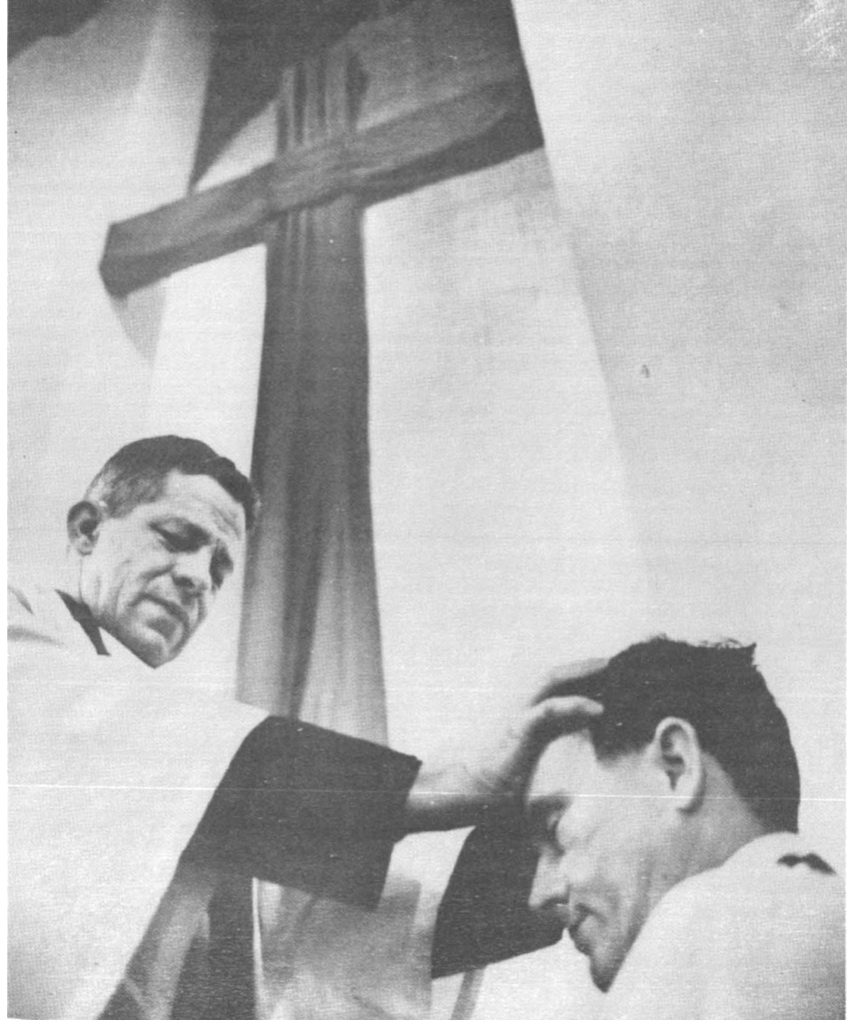
The Anglican Church in North America frequently mentions that it is a three-streams church, with one of those streams being the charismatic (or Pentecostal, or “Spirit” in the formulation “Scripture, Sacrament, Spirit”). When did the charismatic “stream” rise in the life of the Episcopal Church, USA? Although Dennis J. Bennett is frequently mentioned as the pioneer of tongues speaking and the Holy Ghost revival in Episcopal circles; it actually came from the Church of the Resurrection in West Chicago, Illinois. Yes, that Church of the Resurrection, the one that gave us William Beasley and Stewart Ruch in modern times. Trinity Episcopal Church in Wheaton, Illinois established Church of the Resurrection on Palm Sunday in 1954 under the leadership of Fr. Richard Winkler.
According to Kilian McDonnell’s Presence, Power, Praise
In 1955 a Methodist layman by the name of Dunscombe received the baptism in the Holy Spirit under classical Pentecostal influence in a small town near Fort Wayne, Indiana. Dunscombe led a series of informal prayer meetings in Oak Park, Illinois, as a result of which Fr. Richard Winkler, rector of Trinity Episcopal Church in Wheaton, Illinois, received the baptism on April 26, 1956, possibly becoming the first Episcopal clergyman to receive the baptism in the Holy Spirit. Winkler’s church in Wheaton became a center of charismatic influence. To deal with the issues which arose out of this series of events, a special commission reported to Gerald Francis Burrill, bishop of Chicago, on December 12, 1960.
Another account of Winkler’s experience is in James Thomas Connelly’s dissertation Neo-Pentecostalism: The Charismatic Revival in the Mainline Protestant and Roman Catholic Churches in the United States, 1960–1971:
In 1953 Winkler had become interested in the ministry of healing and had begun to conduct weekly prayer meetings for healing in his rectory in Wheaton. These in turn had led him into a wider familiarity with the charismatic ministry, and through a casual acquaintance he was introduced to Reverend John Stiles, as Assembly of God evangelist. On the night of April 26, 1956, at a meeting conducted by Stiles in the Austin Y.M.C.A. in Chicago, Winkler and a layman from his parish experienced baptism in the Holy Spirit and spoke in tongues. Shortly thereafter Mrs. Winkler was baptized in the Spirit, also through Stiles’ ministry.
In Bennett’s famous Nine O’Clock In The Morning he mentions “Father W” who was “the Rector of a good-sized parish in the Chicago area.” This is Rev. Winkler. Bennett was making waves in 1960 when an outbreak of tongues speaking hit him and his church in Van Nuys. Winkler wrote Bennett when the Van Nuys parish started making the news. “Right in the midst of my troubles in Van Nuys, he (Winkler) had written to me to tell me that they had been experiencing the Baptism in the Holy Spirit in his parish for the past five years.” Rev. Winkler told Rev. Bennett:
“Most of my key people have received, and it’s wonderful the way God’s love and joy is being shown in their lives,” he wrote. And he proceeded to encourage me to stand my ground…I had telephoned him and we had had much exchange of correspondence.
Bennett resigned from his Van Nuys parish soon after experiencing the baptism in the Holy Spirit. He moved to Seattle where Bishop William Fisher Lewis seems to have had no problem with his charismatic beliefs. Eventually, Bennett had Rev. Winkler visit during a clergy conference on the Oregon coast. Rev. Winkler had a half-hour before he had to leave for the airport, and he asked, “Is there anyone here who would like to receive the Holy Spirit?” The group said yes. Bennett relates, “I watched as my friend from Chicago laid hands on these people. One after another they were prayed for, and repeatedly and simply we saw and heard the miracle of Pentecost reenacted…Father W. quietly and simply encouraged them to open their mouths and begin to speak “as the Spirit gave them utterance.”
Rev. Winkler’s Church of the Resurrection caused so much concern in the late 1950’s that the Episcopal Diocese of Chicago established a Special Commission on Glossolalia, to investigate and evaluate the charismatic phenomena. The Special Commission’s report was authored by The Very Rev. Canon William Hamilton Nes, a professor of homiletics at Seabury-Western Theological Seminary in Evanston, Illinois. Rev. Nes delivered a report to Gerald Francis Burrill, bishop of Chicago, on December 12, 1960.
The report interestingly distinguished what was going on in Chicago as “spiritual speaking” as opposed to Biblical speaking in tongues:
This has manifested itself in a kind of “spiritual speaking” (to be distinguished from the “speaking with tongues” described in the second chapter of the Book of the Acts of the Apostles, for that was an utterance which conveyed significance in known and identifiable languages) reminiscent of expressions of fervor which characterized the Church of Corinth in the time of St. Paul.
The Commission warned of possible diabolic deception:
The eagerness with which popular curiosity seizes upon stories of such happenings is a clear signal of warning. Furthermore, in anything like “spiritual speaking” which wells up from the mysterious depths of our humanity, where in so many forms primal evil wrestles with the urgency of redemptive good, there is always a most serious danger of delusion, and even of diabolic deception. It is the pastoral obligation of the Church to protect the faithful from any possible incursion of the irrational or pathological forces which prey upon the depths of our nature. “Beloved, believe not every spirit, but try the spirits whether they are of God . . .” (1 John 4:1).
The Commission suggested the following:
1. Separatism and the development of any kind of sectarian spirit is to be deplored.
2. The danger of irrationality and emotional excess is to be acknowledged as a real danger and to be shunned.
3. All Christians must be ready to submit special experiences of this type to the judgment and decision of their pastors.
4. The contemporary fondness for the new and sometimes for the bizarre is a temptation, and must be avoided.
5. Methods of instruction and prayer which are unquestionably grounded in the Holy Scriptures and proven through centuries of Christian practice are to be given priority over methods which rest on tentative if not dubious foundations.
6. Our strongest Apostolic authority is St. Paul (in 1 Corinthians 12-14).
They also concluded:
(a) that the exercise of “spiritual speaking” shall in no way intrude itself into the regular worship and work of the Church so as to disturb the order and peace thereof;
(b) that those who engage in this activity avoid occasion for giving offence to the Church either by exalting themselves or by suggesting that others seek this gift as a mark of spiritual superiority;
(c) that the exercise of this gift be guarded with vigilance so as to protect both the faithful and the weak from the dangers of irrationality and emotional excess;
(d) that the persons who experience this gift consult regularly with their pastors;
(e) that groups of people who exercise this gift under the auspices of any minister of this Church shall, through such minister, report regularly to the Bishop of their activities.
As part of the Commission’s investigation they must have attended a prayer meeting or service in October 1960 and they had these interesting observations as an appendix:
1. This is a special kind of ecstatic activity. It can become routine and imitative, but it can also be unquestionably genuine. There can be no doubt whatever that it is a practice enjoyed by certain sincere people who attribute to it the clue to a complete and desirable change in their outlook and way of life.
2. Its participants are not theologically articulate or systematic. They are divided as to whether it is (a) a latent faculty in everyone (Christian or not), (b) a special gift only meant for some (Christian or otherwise). They seem to agree that it can be given, or awakened by the laying on of hands with prayer by a group — with the earnest desire of the recipient.
3. The practice consists of two phases: (1) a rapid, unintelligible series of utterances, eyes closed, voice quiet, body relaxed — sounding like true language in its inflections and pauses and intonations, seeming very close to various tongues which might be heard any day in the United Nations, and (2) an “interpretation” done in the same manner except in English, consisting of an introduction, “Thus saith the Lord”, and an opening form of address which is always plural and affectionate in the Johannine manner “My little ones”, “Little children”, “My beloved ones”, followed by various admonitions and general promises or warnings, some hackneyed, some sounding rather original, concluding with “Thus saith your Lord” — after which the group joins in “Amen”.
4. It is said that it can all be private and silent; that interpretation can take place without the preliminary “tongues”.
5. Upon questioning, the participants clearly distinguish between the activity of tongues with interpretation and the work of the Spirit: that is, their indebtedness is not to the practice itself but to the sense of the power and indwelling of the Spirit Himself to which the activity attests. As is to be expected, this distinction is not likely to be firmly maintained in personal attitude and general feeling but only during the attempt at objective analysis.
6. There is no sign of disorder, overexcitement, etc. The activity can follow, almost immediately, light conversation and ordinary party-talk, and when all have had their turn, the resumption of casual chatter and objective observations of what has happened is instant and easy.
7. Without exception, all the participants testify that their having discovered this faculty and their regular sharing together of it have made the most profound and permanent change in their lives from top to bottom, all day all night; that it has launched each and every one of them into a moment-by-moment “practice of the presence of God” for which they are obviously grateful to the Lord beyond telling; that the daily routines in home and at work and play, as well as the regular practices of the Churchman’s life have all taken on new meaning and new joy and quiet excitement; that they feel in their spirit and conversation and faces the marks of real and sustained conversion to lives of faithfulness and obedience to God.


Leave a Reply