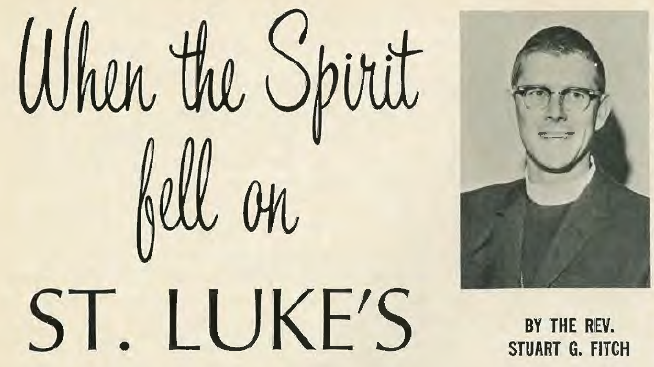
Right at the foot of the San Gabriel Mountains in the sprawl of the Los Angeles metro sits St. Luke Episcopal Church in Monrovia. It was there in the late 1950’s that three men would form another node in a seemingly self-igniting charismatic movement within the Episcopal Church. The staff included the Rev. Stuart G. Fitch and the rector, the Rev. Morton T. Kelsey. Rev. Fitch describes what happened there:
The Spirit fell on St. Luke Episcopal Church Monrovia, in a new flow of activity and quickening in the fall of 1959. This was at about the same time as the increased power and witness of the Spirit in Monterey Park, Van Nuys, and other parts of Southern California, although we were not aware of the synchronicity at the time. A small supportive prayer group was praying simply for an increase of Spirit when the Holy Spirit fell and manifested Himself through tongues, interpretation and prophecy, and the tremendous deep-seated joy that one experiences when he knows the Holy Spirit in so personal a way.1
Fitch was born in Pasadena and had served in the Navy during World War II. He then went to Stanford and was later a reporter in Honolulu before attending the Church Divinity School of the Pacific. Morton Kelsey did his graduate studies at Princeton University. He arrived in Monrovia in 1950 and St. Luke’s flourished but he had a nervous breakdown which led him to talk to Jungian analyst Max Zeller in the early 50s.2 These men were highly educated clergy in one of the leading cities in the world, not tent revivalists.
Father Kelsey traced his interest in tongues to Agnes Sanford, who is probably the true founder of the charismatic stream when you dig deep enough. He wrote that Sanford’s “…interest in healing stimulated my study of the gifts of the spirit.”3 He presented talks on the subject at Sanford’s schools of Pastoral Care. Kelsey did not speak in tongues himself, but later wrote a book on the subject from a Jungian perspective. He says he had high reluctance to write about the subject, but was sitting at lunch with Agnes Sanford when he received a phone call asking him to do so. He was hesitating on the phone and Sanford wrote him a note, “Morton, you never turn down a publisher at the first opportunity you have to publish.”4 Needless to say, he wrote the book. Kelsey says he was a silent partner in the charismatic movement and only ever spoke in tongues in a dream! Kelsey was also an acquaintance of Dennis Bennett, 30 miles away in Van Nuys.
The charismatics at St. Luke went in a unique direction because as Fitch writes “the parish had long been interested in the tools of psychology as religious tools.” Thus while there were the “sign gifts” there were also “lives being released and transformed” with people “being released from bondage, becoming more mature, becoming more whole.” Fitch describes a conflict he had with a female parishioner which in a Jungian fashion he traced to resentment towards his childhood nanny. He reconciled with the parishioner and then had hands laid on him “for this period of my life and any residual ties that still remained alive in me.” This sounds like the nascent teaching of some later charismatics about “soul ties.”
Fitch probably reflected the shared convictions of Kelsey in enthusiasm for the “use of psychological tools and the power of the Spirit working together to transform my life. Psychology alone would be dead.” In 1964 he was very happy about the situation: “And so at St. Luke’s Church there has been a unique blending of the sacramental and prayer life of the Church with the truths of psychology and an outpouring of the Holy Spirit.”
A bit after this experience of charismata another young priest who had graduated from Stanford with a biology degree and gone to the Church Divinity School of the Pacific joined St. Luke. He was the Rev. Adams Lovekin, and he had written what was at that time an unpublished study on tongues, which stimulated Morton Kelsey to write his book. Kelsey also says that Lovekin was interested in and encouraged him to write the book. Many years later, Lovekin expanded his study and with H. Newton Malony turned it into the influential scholarly work Glossolalia, Behavioral Science Perspectives on Speaking in Tongues.5
Morton Kelsey says that when the Diocese of Los Angeles cracked down on tongues speaking St. Luke took in some of the ministers who were in crisis. One of these priests was Father Cameron Harriot who worked there on a voluntary basis during 1964 and 65. This strife in Los Angeles would repeat in many places across the country. Kelsey’s conclusion on glossolalia was:
Glossolalia can be a regenerative influence with relatively few dangers when it occurs within a Christian community in which there is understanding of the mysterious spiritual levels of the human psyche and of the God which touches men at those levels. In such a group speaking in tongues would not be normative and so never forced. It would likewise never be forbidden. When it was spontaneous, it would be viewed with tolerance and understanding by those who did not experience it, and with humility and modesty by those who did. Tongue speakers would not separate out from those who find their religious fulfillment in other ways. Both would learn from one another and their different ways. They would try to understand their experiences in the best theological context which they are able to formulate, each taking into account the point of view of the one who differed from him.
- Fitch, Stuart G. “When the Spirit Fell on St. Luke’s.” Trinity Magazine, vol. 1, no. 3, Whitsuntide 1964, p. 32. ↩︎
- See https://desertroadministries.org/finding-a-spiritual-guide-the-story-of-morton-kelsey/ for a summary. ↩︎
- Kelsey, Morton T. Tongue Speaking: An Experiment in Spiritual Experience. Doubleday, 1964. Internet Archive, archive.org/details/tonguespeaking0000mort. Page viii. ↩︎
- Kelsey knew Sanford’s son through Camps Farthest Out. See https://youtu.be/qZRdhwUl-QQ?si=Rtlogo3qs9QZW-fQ. ↩︎
- Malony, H. Newton, and A. Adams Lovekin. Glossolalia: Behavioral Science Perspectives on Speaking in Tongues. Oxford University Press, 1985. Internet Archive, archive.org/details/glossolaliabehav00malo. ↩︎
Leave a Reply