
Where does the buck stop in the ACNA? Is anyone responsible for anything or do clergy get to say, “mistakes were made” and leave a trail of destruction in their wake? The ACNA has a Constitution, and in Article I, Declaration 6 says:
We receive The Book of Common Prayer as set forth by the Church of England in 1662, together with the Ordinal attached to the same, as a standard for Anglican doctrine and discipline, and, with the Books which preceded it, as the standard for the Anglican tradition of worship.
The 1662 Ordinal is supposed to be the standard for discipline.
PCA pastor Joshua Moon was arrested on September 11, 2013 for attempting to solicit a female prostitute in Plymouth, Minnesota. He pled guilty on February 27, 2014, and was sentenced to 90 days in the Hennepin County Corrections Workhouse. A year or so later, he was preaching at Church of the Cross in Hopkins, MN. On February 5-7th 2016 Moon was the featured speaker for a men’s retreat at Cove Point Lodge in Beaver Bay, Minnesota. On October 28, 2020, Moon was ordained a priest in the Upper Midwest Diocese.

According to reporting by the Washington Post, Moon went on to make an unwanted sexual advance on a female deacon from his church on June 9, 2022. Bishop Ruch was on a leave of absence, but he was able to chastise this female deacon her for being alone with Moon in any setting. He offered her a prayer of absolution for her “sin,” she said.
In 2023 Bishop Ruch said, “I made an error in judgment in ordaining Josh to the priesthood” and “I made the wrong judgment.” According to the Court in his trial, “In retrospect, and with the benefit of subsequent growth and experience, Bishop Ruch testified that he would not today support Moon’s ordination.” The Court chalks this up to learning on the job and maturing–sorry he ordained a criminal who went on to commit an unwanted sexual advance on a fellow clergy member, oops.
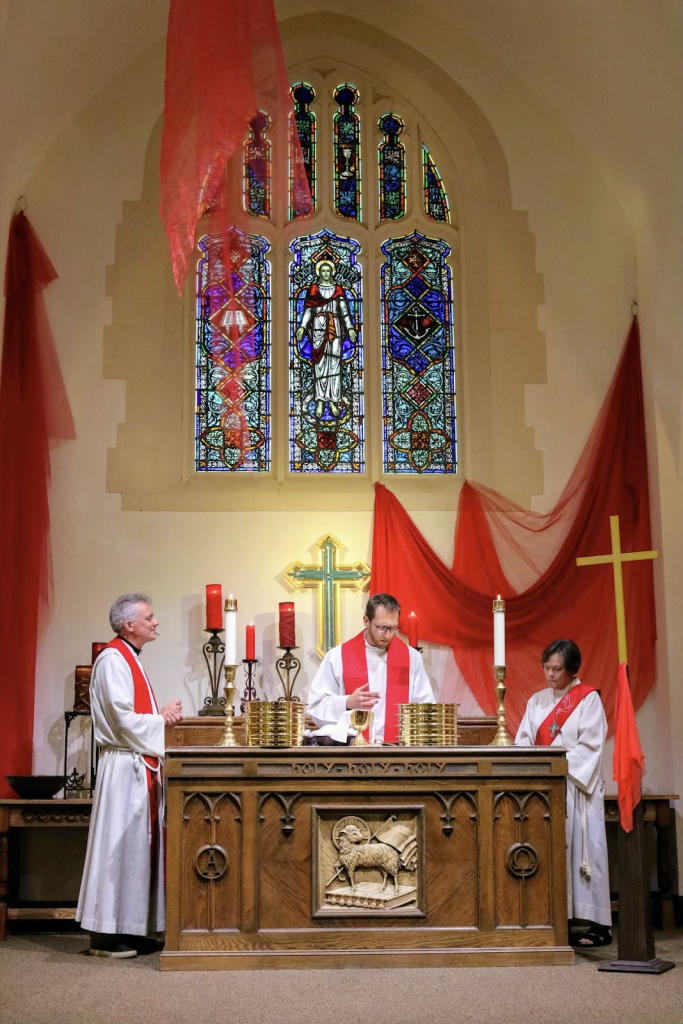
Remember, the 1662 Ordinal is supposed to be the standard for discipline. What does it say about ordaining priests? The 1662 Form and Manner of Ordering Priests says:
Good People, these are they whom we purpose, God willing, to receive this day unto the holy Office of Priesthood; for, after due examination, we find not to the contrary, but that they are lawfully called to their Function and Ministry, and that they are persons meet for the same. But yet, if there be any of you who knoweth any Impediment, or notable Crime, in any of them, for the which he ought not to be received into this holy Ministry, let him come forth in the Name of God, and show what the Crime or Impediment is.
This is repeated in the current ACNA BCP:
Dear Brothers and Sisters in Christ, you know the importance of this ministry, and the weight of your responsibility in presenting N.N. for ordination to the sacred Priesthood. Therefore if any of you know of any impediment or crime because of which we should not proceed, come forward now and make it known.1
Who could have stepped forward to stop this disastrous ordination in 2020? Not me. I had moved away and had no knowledge of Moon’s criminal history. What about the other parishioners? Is it their fault for not raising a hand during this pandemic ordination? No, because they were also not told about this. The person who knew the most about the situation was Bishop Ruch.
How important is the background of the candidate for ordination? The ancients thought it to be of the utmost importance. Richard Hooker in Of the Laws of Ecclesiastical Polity Book V, Chapter 81, Section 2 wrote:
I cannot see what one duty there is which always ought to go before ordination, but only care of the party’s worthiness as well for integrity and virtue as knowledge, yea for virtue more, inasmuch as defect of knowledge may sundry ways be supplied, but the scandal of vicious and wicked life is a deadly evil.
Hooker is saying that a candidate can learn more head knowledge, but that a sinful character is a deadly evil. In Newport J.D. White’s commentary on I Timothy and Titus, he remarks on the requirements for an overseer:
The episcopus is the persona of the Church. It is not enough for him to be not criminal; he must be one against whom it is impossible to bring any charge of wrong doing such as could stand impartial examination…the deacon must be…one against whom no charge has, in point of fact, been brought.
For the Apostle Paul and therefore for us as Christians, the standard for ordination is very high. In The Annotated Book of Common Prayer: Being an Historical, Ritual, and Theological Commentary on the Devotional System of the Church of England edited by the Rev. John Henry Blunt, in the commentary on the Ordinal, we find him citing a Pontifical Instruction existing before the year 800 AD:
Brothers, the rule of safety or danger is the same for the one who governs the ship and for the voyage itself. Their judgment ought to be common whose cause is common. Nor without reason have we received from the Fathers the institution that, concerning the election of those who are to be admitted to the governance of the altar, the people also should be consulted.
For what is sometimes unknown to many regarding the life of those presented is known to a few; and approval is more rightly given, and ordination more easily commended, when consent is granted to the one being ordained.
The life of these our brother presbyters, as far as it appears to me, is approved and pleasing to God, and worthy, I judge, of an increase in ecclesiastical honor. But lest perhaps the assent of one or a few, or misplaced affection, deceive us, the judgment of many must be awaited.
Therefore, what you know of their deeds or character, what you think of their merit, we ask you before God as witness. For your faithful charity ought to act according to the evangelical command—to show love toward God and neighbor—so that by these testimonies the priesthood may be more helped than harmed.2
The ancients as you can see took this very seriously and wanted to hear if there was some scandal that should be known about a prospective priest. Our Ordinal repeats this serious call for testimony against candidates. In other words, the Ordinal tells us that what Bishop Ruch did in ordaining Moon should never have happened. He violated the Ordinal.
Consider a previous case in the ACNA, that of former Bishop James Hobby. In his case, the Diocese of Pittsburgh says that he, “Failed to act with urgency, transparency, and timeliness when an accusation of sexual misconduct by a member of the clergy was brought to his attention. To be clear, this misconduct involved another adult who is a clergy member.
Failed repeatedly to act in a manner that demonstrated proper concern for the victims of an abusive priest. To be clear, this abuse related to adults and did not involve physical contact. Repeatedly failed to properly follow the Canonical process for this accusation. Inexplicably delayed in advising the Standing Committee of other formal complaints about the same clergy member. Did not share material information regarding the investigation with the Standing Committee and the Canonical Investigator in a timely manner.”
Instead of a group of loyalists attributing these failures to an attack of the enemy and defending the leader at all costs, “…the Standing Committee unanimously concluded that Bishop Hobby had broken the bond of trust essential to the office of the Bishop, it consulted with Archbishop Foley Beach and Canon Phil Ashey, who serves as Special Counsel to the Archbishop, and received their advice. The committee then unanimously agreed to ask Bishop Hobby to voluntarily resign. Bishop Hobby was aware that he could reject this request and go through the formal Canonical process set forth in Title III, Canon 8, Section 8 of the ANCA Canons. In response to the committee’s request, Bishop Hobby chose to resign.”
I suggest that Bishop Ruch’s ordination of Moon was every bit as much a breaking of the bond of trust if not more so, and yet his response was totally different.
Even after Moon was defrocked parishioners heard very little of the truth. One told me, “I heard that Moon was defrocked back in 2022, but I never knew the details. I was basically told no one allowed to talk about it when I asked.”
The presentment against Bishop Ruch helpfully mentions the Ordinal in its Sections III and IV. It contains pages of detail on ordination vows. This would lead you to think that at the very least, the Court would have explained in detail how they think Ruch did not violate the Ordinal. Instead they imply that disagreeing with Moon’s ordination is simply a “disagreement with leadership decisions.” They call Moon’s unwanted sexual advances which the deacon in question calls sexual assault “crossing inappropriate boundaries”—a favorite euphemism of ACNA clergy.
Bishop David Bryan, Rev. Jeff Weber, Bishop David Hicks, Bishop Quigg Lawrence, Rev. Jonathan Millard, Katherine Grosskopf, and Larry Doyle tell us “that vigilance did not cease once ordination had taken place” despite the fact that it absolutely did. “Vigilance” occurred after a sexual offender made unwanted sexual advances again. “Vigilance” occurred when a sexual offender was sent to plant a church with a female deacon who did not know of his criminal past. “Vigilance” occurred by placing a gag order on a deacon during a key time in the court process and then extending her suspension by nine months in an action that Archbishop Beach himself determined was uncanonical.
No one knows the future. No one needed to know the future in this situation. It was not necessary to foresee what Joshua Moon would do. It was necessary to heed the Scripture “The overseer then must be above reproach” and to heed the Ordinal, knowing that there was an “Impediment, or notable Crime…for the which he ought not to be received into this holy Ministry.” Instead, the Court tells us that “His approach reflected an attempt to balance pastoral compassion for a repentant believer seeking restoration with the Church’s obligation to safeguard its people.”
The bishop failed to guard the flock. The Court failed to discipline him for doing so. The Ordinal was not followed. Scripture was not followed. “Woe be unto the pastors that destroy and scatter the sheep of my pasture! saith the Lord.”
Leave a Reply