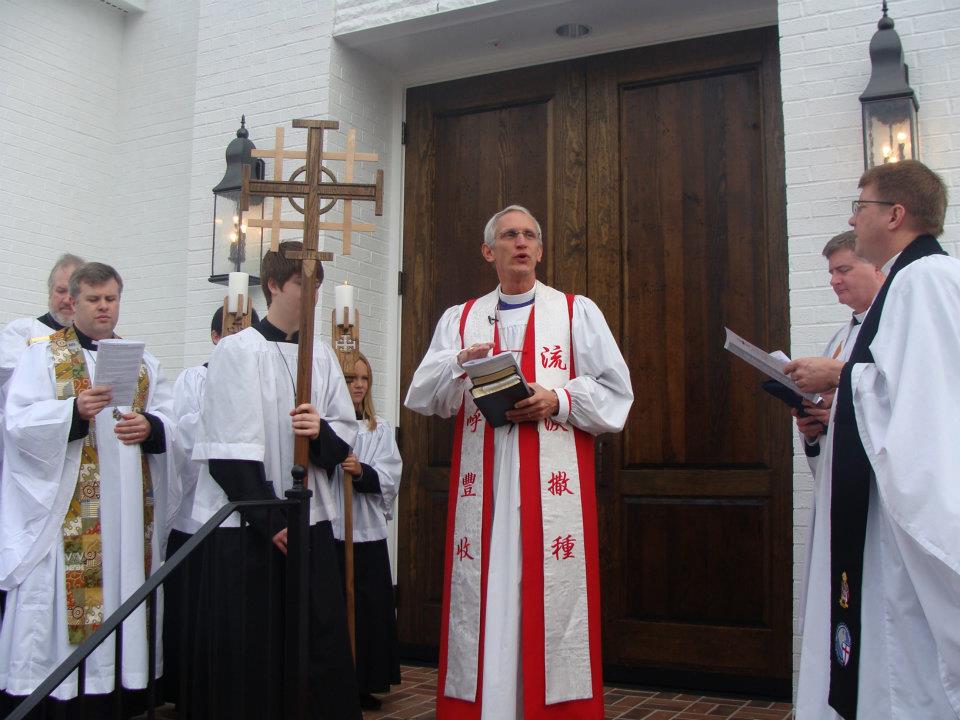
Before proceeding to the major events which followed the meeting in Arlington between Archbishop Rwaje and Bishop Murphy, it may be instructive to look at a bit of what was going on around the Mission. For example, Terrell Glenn consecrated a new building for AMiA’s Church of the Apostles in Columbia after his resignation. Glenn’s action did not seem like he was a resigned bishop who was heading out to retirement, and indeed he wasn’t.
Although most of the conflicts occurring at the top levels of leadership boiled down to personality clashes, grudges, or power-seeking, some people took theological questions seriously. For example, in November the Rev. Canon Mark Rudolph, an AMiA priest at St. John’s Anglican Church in Philadelphia responded to Kevin Donlon’s paper, which was itself a response to the first Washington Statement. Rudolph’s reply was titled A Critique Of Impure Reason, A Response to the Reverend Doctor Kevin Donlon’s Canonical Justification For Leaving Rwanda.
I don’t know how widely Rev. Rudolph’s paper was circulated or if it helped influence clergy’s decisions on which side to choose. Rudolph’s abstract said, “I conclude that Donlon’s arguments are largely irrelevant as to the question at hand. In fact, the only way in which Donlon’s response is relevant is that he helps demonstrate that Pawleys’ proposal is at best very unusual in the history of the church, if not unique.”
Under Murphy’s proposal, missionary bishops would serve in a “Conference of Bishops” with no authority except that granted by the ordinal or delegated by the Apostolic Vicar. Rudolph argued that Donlon’s defense of this lack of authority was “…tautological. The position being argued – lack of authority for the missionary bishops – is neither defined, nor defended. It’s just put into different language with similar meaning.”
Murphy’s proposal embraced a “two integrities” approach to women’s ordination, which Rudolph called “illogical and irrational,” saying it violated the law of non-contradiction and shifted the responsibility of defending the faith from bishops to presbyters. Bishop Murphy expressed concern that future Archbishops of Rwanda might not renew the AMiA’s “prelature,” potentially jeopardizing its Anglican legitimacy. Rudolph questioned why, if this was an “overarching canonical fact,” it was not addressed earlier in the canons drafted by Donlon himself. While Donlon claimed that the AMiA staff would answer to a “College of Presbyters,” Rudolph noted that the AMiA had historically “quashed” efforts toward formal collegiality and that previous councils were often dissolved or ignored.
As the conflict rippled out across congregations, my own parish, Church of the Ascension in Arlington Virginia, was caught up in confusion. On November 20th there was a congregational meeting with the intention of amending the parish by-laws to move us out of AMiA and prevent our pastor Chuck Colson from being disciplined by Chuck Murphy. The congregation was not abreast of all the back and forth in the Anglican online universe and was puzzled by the sense of urgency. It turned out that changing the bylaws also required a notice waiver which had not been issued, so the meeting ended inconclusively and the process stretched into December. Although these events are not important to the big picture, they illustrate the confusion that descended on all AMiA parishes. Unless you were plugged in to Anglican news–and how many people really are?–the sudden need to choose a new affiliation or to weigh matters that you had never heard of was bewildering. The basic message had always boiled down to: “Rwanda is great and we love its leadership.” Now the implication from Pawleys Island was that “some Rwandans are great but others really aren’t” and the young Reformed pastors from D.C. were talking out of turn and causing problems.


Leave a Reply