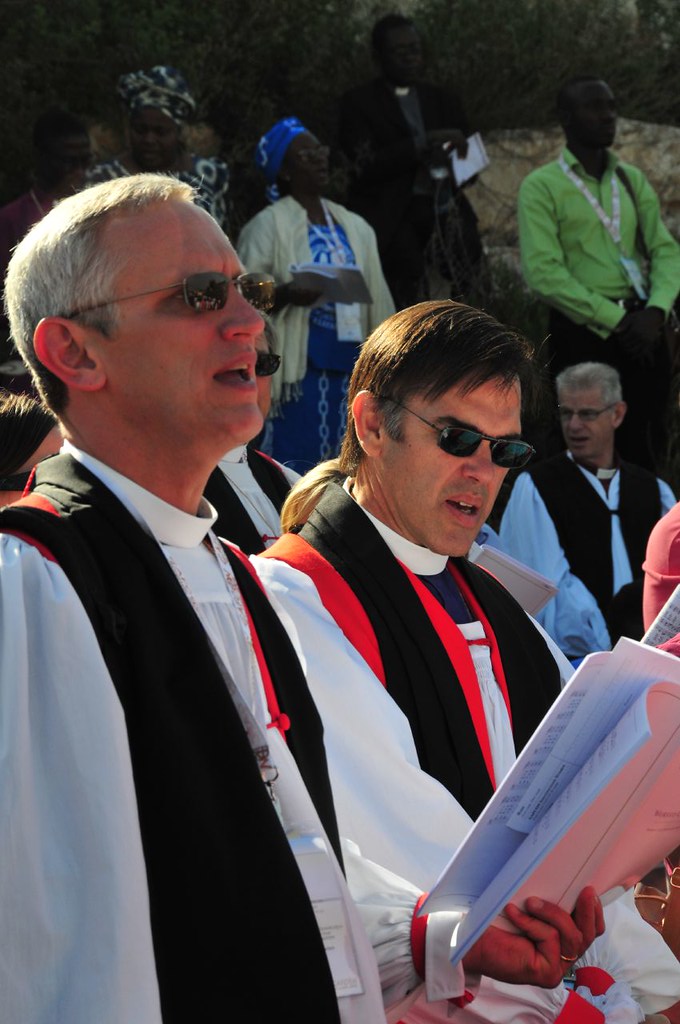
For months Bishop Terrell Glenn and his wife Teresa agonized in prayer about what to do about his leadership position within the AMiA. He had personal issues with Bishop Murphy that he could not resolve and many of his clergy–notably the D.C. authors of the Washington Statement–were unhappy with where things were headed. Apparently there had been years of tension between Glenn and Murphy. Glenn became the pastor of All Saints, Pawleys Island in 2005. When Glenn became rector, All Saints’ seeker service “Access Pawleys” moved out to become its own church plant, led by Tim Surratt. Bishop Murphy was attending Access Pawleys in 2011 at the time of the conflict.
Bishop Murphy later said that there was “a growing discontent amongst the Apostles Mission Network” and that he was getting “disturbing emails from people in that orbit.” He said, “I talked to Terrell about setting tone and direction. It never really got the reactions I hoped it would get. In fact, the internet is an indicator that it got worse, especially Washington.”
On Sunday November 6, days after the Washington Statement was sent out, the D.C. clergy did not check their inboxes because they did not want to know if Bishop Murphy had inhibited them before their Sunday services. On the other hand, Rev. Colson received supportive emails from priests throughout the USA and Africa thanking him for what he and the other clergy did in publishing their paper.
Many AMiA clergy were shocked and confused. Reverend Craig Heenan was perhaps typical of this category when he wrote, “As a pastor in the AM, my greatest present concern is the issue of the disbursement of funds at the national level. This is not a new issue. It’s been a source of concern for several years and repeated requests for detailed accounting simply have not been met in anything like the detail needed. This is a particular source of concern for me as a pastor, because one of the great blessings of service in the Mission has been the simplicity of describing it’s funding philosophy. When we first formed our congregation, we explained to our members the 10-10-10 principle in which we ask our congregation members to give 10%, our congregation gives 10% the national organization, and, we understood at the time that the national organization forwarded 10% to Rwanda. It was a simple system and easy to explain to newcomers as well. But the thing is, that while we as a congregation are operating under that system, there’s no documentation I can point to showing that the funds we pass along are being used as we assumed. I’ve concluded that I can no longer preach on the 10-10-10 principle as long as these serious questions remain and our vestry is exploring options on how we can ensure that our congregational offering is used in the ways we expect. This seems to be a matter that can no longer be put off.” The financial issues would persist as a concern, perhaps because the two categories of scandal that get people agitated are generally sexual or financial.
Kevin Donlon authored a scattershot response to the Washington Statement. One of his fellow priests ascribed great confidence in Donlon’s response saying, “I will defer to “FACTUAL THEOLOGICAL AND CANONICAL CRITIQUE OF Is the AMiA’s New Missionary Society” Structure the Best Way Forward?” by Kevin Francis Donlon as the document of record and correction.” Donlon’s written response to the Washington Statement was however almost an email, with responses inline in red text, with typos, grammatical errors, and a long bibliographical list of works on canon law for the D.C. clergy to educate themselves with. The prolific blogger Robin Jordan was also in communication with the D.C. clergy and he wrote an extensive inquiry into what Donlon seemed to be doing within AMiA.1
On Thursday November 10 the AMIA Council of Bishops met in Myrtle Beach and the conflict between Murphy and Glenn came to a head. The D.C. clergy fasted and prayed for the bishops meeting but did not hear anything from bishops Glenn or Barnum during the meeting, indicating that they were under a gag order. When news did emerge from the meeting, it seemed like a large setback for the Apostles Network clergy who were skeptical of Bishop Murphy, because their defender Bishop Glenn had resigned. Glenn had a reputation for sterling character so for him to jump ship was another shock to the AMiA system.
Bishop Thad Barnum recounted the November 10th meeting:
This was proven at the November AMIA Council of Bishops meeting in Myrtle Beach as the new Missionary Society took center stage. Except for Bishop Terrell Glenn and me, all the bishops declared their enthusiastic support of the Society, our Chairman, and our most respected retired archbishops.
But for me, I announced, I’d not be going into the Society. I knew there’d be clergy and congregations that would want to remain in the Province of Rwanda, under the authority of our Archbishop, and would not want this change. I asked my colleagues to support me in pastoring these churches.
Although my proposal was accepted, another story, a bigger story had emerged. For it was at this meeting Bishop Terrell Glenn submitted his resignation from the AMIA Council of Bishops citing a broken and unreconciled relationship with the Chairman. This resignation became the headline news coming out of our November COB meeting.2
On November 11th, Bishop Glenn sent out a letter announcing his resignation and alluding to ongoing conflicts he had with Chuck Murphy. He asked that discussions about the future of AMiA “be conducted in a manner worthy of the Gospel, that honors the leadership of the Anglican Mission and that is above reproach in every way.”3 Bishop Murphy later said that “I was surprised that Terrell’s statement referenced a conflict with me.” The press release that came from the AMiA Council of Bishops on the same day emphasized the bright side of events, “Both the Glenns and all members of the Council of Bishops and their wives expressed mutual love and respect for one another.”
Apropos of what the unhappy clergy could do with Bishop Glenn gone, one of the D.C. clergy told me, “We have options…but easiest just to take a Rwandan bishop temporarily…It is good in that (Bishop Glenn) is ready to lead us into new territory. This will take some time though. It is bad in this way: if Murphy makes the resignation effective immediately, we are under his oversight. This is why we want to fall off the face of the planet. We are working on options right now.”
On November 12th Chairman Murphy decided on a replacement for Bishop Glenn and announced, “I have appointed the Rev. Dr. Bob Grant as Episcopal Vicar of the Apostles Mission Network for this transitional period. Bob is a seasoned priest with strong pastoral and relational skills; he also has experience working with clergy and congregations in transition. Bob is available to work with you on my behalf, to answer questions during this time of discernment.”4 I don’t believe that anything came of this move to Bob Grant, because events were picking up pace.
- Available at https://anglicansablaze.blogspot.com/2011/11/what-future-holds-for-anglican-mission.html accessed on 4 March 26. ↩︎
- First Steps Toward Reconciliation And Why I Decided to Stay in Rwanda, Bishop Thad Barnum. ↩︎
- I am writing to inform you that I have resigned from the Anglican Mission in America. I communicated this to my brother bishops earlier this week at our fall retreat in Myrtle Beach and submitted a letter to that effect to Bishop Murphy, our Chairman and Archbishop Rwaje’s Primatial Vicar. This is not a decision that I have made lightly or in haste or in reaction to any of the impending decisions about the future direction of the Anglican Mission that are before the Council of Bishops and the Anglican Mission. Rather, it is a decision that Teresa and I have made after several months of agonizing prayer as we have sought to do what we believe the Lord has called us to do.
For a while now, Bishop Murphy and I have sought to resolve personal issues between us. Regrettably, we have been unsuccessful. As Teresa and I prayed about this, we came to believe that the Lord was leading us to step out of the Anglican Mission and we are doing this in obedience to Him. In anticipation of this decision, we sought to hear the Lord about next steps but only heard Him clearly about this one. Therefore, we now are entering a period of discernment as to our future ministry.
There are two things that I ask of you at this time. First, please do not take our decision as an indication or recommendation from me as to what any of you should do in response to the proposed changes in the life of the Anglican Mission as it considers becoming a Missionary Society. Instead, I ask that you remain faithfully a part of the Anglican Mission and a vitally prayerful part of the process of discernment in which the Mission is currently engaged concerning its future. This means that discussions among you should be conducted in a manner worthy of the Gospel, that honors the leadership of the Anglican Mission and that is above reproach in every way. Second, and more personally, I ask for your prayers for direction for the Glenn family as we seek our Lord’s will for our lives.
Over these past three years and especially in this recent season in which I have been able to give a singular focus to serving as your bishop, Teresa and I have been blessed not only to deepen ministry relationships with you, but also to foster friendships. Truly, it has been an honor, privilege and joy to serve as your bishop. Teresa and I love you deeply and you will remain in our prayers.
Glenn, Terrell. “Resignation Letter.” 11 Nov. 2011.
↩︎ - Murphy, Charles H., III. Letter to Clergy of the Apostles Mission Network. 12 Nov. 2011. Personal collection. ↩︎
Leave a Reply