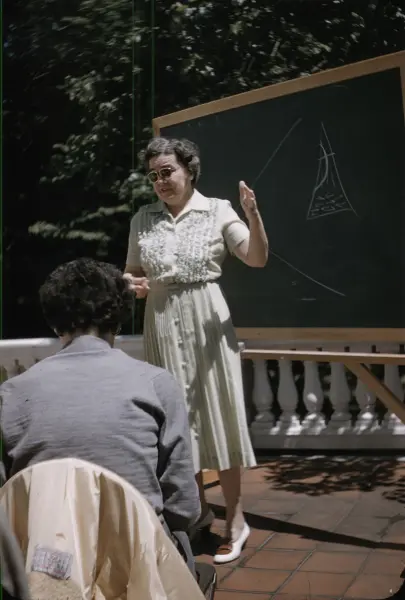
The Rev. Ted Sanford II (1889–1960) was an Episcopal priest and principal of a Christian school in China when he met Agnes White and married her in 1923. Agnes was the daughter of Presbyterian missionaries to China and she had grown up and been home schooled there. From 1926-1949 Rev. Sanford pastored Trinity Episcopal Church in Moorestown, New Jersey before moving to St. Stephen’s Episcopal Church in Westborough, Massachusetts.
Agnes Sanford’s missionary father Hugh Watt White had several encounters with demonic possession while in China and wrote a book about it called Demonism Verified and Analysed.1 The book both disagrees with those who would attribute demonic activity to purely mental disorders, and allies itself with emerging science and psychology. Agnes seems to have been formed heavily by this approach which emphasized what the Bible taught, was dissatisfied with an arid cessationist theology, and looked to people like Jung for insights into the spirit.
At a young age Agnes asked her mother about John 14:12, “He that believeth on me, the works that I do shall he do also.” Her mother told her that the age of miracles was past, which did not satisfy young Agnes. Much later, she encountered an Episcopal priest, the Rev. Hollis Wesley Colwell. Rev. Colwell was part of a large upsurge in the healing ministry within early 20th century Episcopalian circles. According to William De Arteaga, “He believed that a necessary ingredient of the healing ministry is an adherence to a strict health-food regime following that of the Rev. Robert B. H. Bell.”2 Sanford’s infant son had a severe ear infection in those pre-antibiotic days. Rev. Colwell prayed for his healing and Sanford writes “The child shut his eyes, grew very pale as the fever died out of his face, and went to sleep. And when he woke up, his temperature was normal and his ears were well.”3 I should note here the influence of “New Thought” which I don’t have time to delve into right now but which was another foundational aspect to the thinking of Sanford and many others at the start of the charismatic renewal.
The healing of her son fundamentally reoriented Sanford’s spiritual life. She had also prayed for the child’s healing and her prayers had gone unanswered, why? She attributed it to a lack of faith, darkness, and resentment. She was struggling with deep depression. She made an appointment with Rev. Colwell to ask for his prayer for her depression. She mentions cases she knows of where people in her state of mind went to see a pastor and because they merely talked and counselled without praying for the person, the person committed suicide almost immediately. She was experiencing that level of depression and was worried for her own safety. Colwell laid his hands on her and prayed for the healing of her mental depression and it immediately lifted. “Great waves of joy flooded my mind!” She recalled. She sang and shouted all the way home. She was forever changed, not in that she never experienced depression again, but because she was convinced that healing did happen today and she knew it by experience, not from a book.
I won’t try to recreate her entire biography here as she has been much written about. Her importance for the history of the charismatic stream within both TEC and later ACNA cannot be overstated. She and her husband Ted started the School of Pastoral Care, week-long seminars she and Ted gave on the healing ministry. These seminars were restricted to “clergy, their wives, and professional church workers” at first.4 Those who went were sequestered, visitors were not allowed in. Agnes did not “encourage argument, but only study and the quiet contemplation of ideas that are ageless, but that to some may seem new.”5 Agnes wrote that “The main purpose of the School of Pastoral Care is to teach ministers that area of the Christian faith that is not taught in seminaries: healing of soul, mind, and body through faith and prayer.”
During a period of fatigue in 1953, Agnes and her friends and prayer partners Marion Lovekin and Mildred spent four days in a private prayer retreat. They were led to pray for the Holy Ghost and as Agnes said “You know, in general, you get what you expect. Jesus said it this way. According to your faith, be it unto you.”6 They prayed, “Now Lord, we don’t know what you mean by this. “Pray for the Holy Ghost.” But whatever the Holy Ghost is, we know we’ve got to have it because if you want us to do your work, you’ve got to give us the power to do your work. So now, whatever this is, Lord, we’re just going to stay right here until you give it to us.” She explains what happened next in a 1972 talk she gave at Camps Farthest Out (CFO), Capon Springs, West Virginia:
Now, all three of us received at that time what I can just call a magic gift of joy. And this was not the excitable. There was no excitement about this. You may have gathered by this time that I do not depend very much or think too highly of a mere arousing of the emotions. You know, jump up, down, and holler and so forth and carry on. It’s all right, but it doesn’t particularly appeal to me. I don’t fully trust it, being quite cynical by nature. And this was not, though it may be okay for some people, but this was not like that at all. And this was not a surface kind of a joy.
Until now, as I’ve told you before, having been through deep depression, quite suicidal, and everything else for eight years, and bits of it off and on nearly all my life, I had inside of me a kind of a load of sorrow that just never did seem to go away. Now, it was not an active sorrow. And when I was awake and active and doing things and with people, you know, like this, I could be very happy. But when I went to bed at night or when I was alone by myself or when I woke up in the morning, there was all this, always this heavy feeling inside. Just almost you could almost feel it physically like a lump. You know, I wonder if you know what I mean. I’m afraid you do, but you don’t have to have it.
It wasn’t too bad. Anyway, I had really overcome the depression or the Lord had overcome it. And I thought, “Oh, this is nothing. This is just being adult. This is just the way it is when you grow up, you know.” Oh, let me tell you something. It’s not. I thought it was normal for a grown-up person to go around, you know, with this sort of heaviness in the middle.
No. For a Christian, that’s not normal. And it was taken away instantaneously and absolutely miraculously in about one minute by the clock by that one prayer by the Holy Ghost. And it has never come back again. Now, that doesn’t mean I haven’t had rough times. The devil is more apt to be out to get you when you’ve got the Holy Spirit than when you haven’t.
And life on the outside has been quite rough at times since, more so than before, I guess. But in spite of that, there has always been that reservoir of joy inside. Like a spring of water bubbling up, sometimes bubbling low, other times bubbling up real strong and bright, but never gone. Never. I reckon this is what Jesus meant in St. John 4 when he talked to the woman at the well, you know, and he said, “Who so drinketh of the water that I shall give him shall never thirst again. For the water that I shall give him shall be within him a well of water springing up unto everlasting life.” That’s two or three verses put together. But that’s the idea. It happened.
Then there was another gift that Jesus himself promised that all three of us received at that time. In this same discourse, Jesus promised that he was going to give us his peace. He said, “Peace I leave with you. My peace I give unto you. Not as the world giveth give I unto you. Let not your heart be troubled, neither let it be afraid.” You know, that’s been my favorite verse all my life. My dear mother made me memorize the scriptures every day. And I tell you, I am more grateful for that. And from the time I was a little child, tiny child, that verse about peace, I used to use it when I was scared of thunderstorms. I’d say it over and over and over till the fear would go away. But now he gave us his peace in a different kind of a way. We did not recognize it at first. We did not realize that anything had happened to us.
But you know when I first realized something had happened was a few days later when I began to notice that everything I did could be done in about half the time and about a third of the energy that it used to take me. Now, that’s really true. It used to take me about an hour and a half to cook dinner for maybe about six people. Uh that doesn’t include dessert. I always have fruit or ice cream or something. And I don’t cook dinner though by opening packages or cans. I can tell you that. But, you know, after this, I could cook the same dinner and get it on the table in half an hour. Now, I wasn’t hurrying. I wasn’t doing anything different.
You know, to me, that’s the most delightful thing of all. Some people think if they get the baptism of the Spirit, from then on they’re going to float around on a cloud. I’m telling you, from then on in, you’re going to get in the kitchen and cook dinner done better and faster than you ever did before. In other words, the Holy Spirit is intensely practical.
Now, what really did happen? I think it was something like this. Now, let me see if I can explain this. I wish I had a blackboard. Well, anyhow. You have a conscious mind and you have a subconscious or unconscious mind. And besides that, you have a spirit. The spiritual body. Now, until you receive the Holy Ghost, your spiritual body is kind of like it was off to one side. I mean, it’s not fully integrated. But I think what happened was that the energy of the spiritual body at this time moved in and became completely integrated with both the conscious mind and the subconscious mind. And the result was that everything that one did including writing and getting up a lecture or anything could be done with about half the energy or half and half the time. You see, for the most part, we go through life sort of like an automobile with six cylinders, and we’re only using four. We use the strength of our conscious minds that we think with and we use the strength of the unconscious mind working through the body. But we’ve got two other cylinders, only it’s more than two really. The strongest part of us is the energy of God moving through the spirit. So that gift happened to all three of us.
And then the other thing that came to us all immediately was the other promise of Jesus. He said that because he would go away, therefore God would send the Holy Spirit, the comforter. And he said the Holy Spirit will lead you into all truth and make known to you all things that I have said. He’s uh not the exact verse, but they’re pretty near. You find that, I think, in St. John 15. Now, do you know here I was a more than middle-aged woman before I even knew that the Holy Spirit could really speak to you. Now, as a matter of fact, I’m going to tell you, I was brought up with the I was taught actually that the Holy Spirit ceased to speak to man when the last verse of the book of Revelation was written just as I was taught that it was a new dispensation and the Holy Spirit ceased to do miracles. Now, this happened hundreds of years ago. It was not my parents’ fault. It was not the fault of the church or the mission. But these false concepts got into the church. So here I found and all three of us did that God was talking to us. Why? We’d wake up at night. We were too excited and thrilled to sleep much that first night. We wake up at night and think of one of the problems of life.
And it was just like there was a voice inside of us saying, “Look, this is the way.” And there it was. It had just come clear. So I realized later, a long time later, that that was the gift of truth. Now Jesus promised those three gifts and I do think they well…I know from my own experience they were the primary gifts.
Not long after this experience, in late 1953 Marion Lovekin wrote to Agnes that she “had attended a Pentecostal group and now spoke with tongues.” Agnes was horrified by this and wrote Lovekin back telling her so. Lovekin replied, “You are a Bible teacher. How then can you refuse even to contemplate something that is right out of the Bible?”
Agnes said she would let Lovekin and her friend Mildred pray for her to receive “whatever gifts of the Spirit he wants to give” the next time she was in Tucson. They did so in 1953, the three women sitting in a circle, two of them praying in tongues. They laid hands on Agnes and she recalls, “Immediately I desired the gift of tongues with a great longing! And in another moment I spoke as they had spoken, in words that the conscious mind did not understand”
At first she kept this to herself but during a visit to Florida she talked to Catholic charismatic Grace Munsey who told her she had been speaking in tongues for twenty years, so from approximately 1934! Agnes told no one at her home parish about tongues and did not even tell her husband for several years. James T. Connelly writes:
At the School of Pastoral Care she did not encourage speaking in tongues in her lectures, nor did she allow others to do so for fear that it would distract people from learning about the ministry of healing. Nevertheless, through Mrs. Sanford’s private instruction and prayer or in small cells that gathered during a School of Pastoral Care, many of the clergymen who attended were led to the experience of being baptized in the Spirit and speaking in tongues. Since these clergymen in turn introduced others in their congregations and among their friends to these experiences, Agnes Sanford was one of the people most responsible for making current in the historic Protestant denominations the concept of a baptism in the Spirit and the practice of glossolalia. Although she always cautioned those whom she introduced to these experiences to be wary of speaking about them to others, her counsel was not always followed.7
I believe this experience of Agnes Sanford to be the true origin of the charismatic stream in the ACNA, not the later experience of Dennis Bennett in Van Nuys. As I have already written, Tod Ewald and John P. Ashey became charismatics at a CFO conference run by Agnes Sanford, Richard Winkler was influenced by her and had her run seminars at his parish, Morton Kelsey began looking into the Pentecostal experience based on her teaching, and I’m sure many other clergymen encountered speaking in tongues either at the School of Pastoral Care or Camps Farthest Out in the Fifties. As Alan Petigny has shown, the Fifties were the actual decade when the “permissive turn” occurred in the United States, when “…the popular ingestion of modern psychology, coupled with significant changes in child-rearing and religious practices, constituted an unprecedented challenge to traditional moral constraints.”8 This almost underground movement started by Agnes Sanford spread out and then exploded in the 1960s, upending what had been a staid Episcopal Church.
- White, Hugh Watt. Demonism Verified and Analyzed. United States, The author, 1922. ↩︎
- De Arteaga, William. Anglican Healing Awakenings: Saints, Heroes, and Villains (pp. 170-171). (Function). Kindle Edition. ↩︎
- Sanford, Agnes. Sealed Orders: The Autobiography of a Christian Mystic. Logos International, 1972. Page 98. ↩︎
- Connelly, James Thomas. Neo-Pentecostalism: The Charismatic Revival in the Mainline Protestant and Roman Catholic Churches in the United States, 1960–1971, page 94. ↩︎
- Sanford, Agnes. Sealed Orders: The Autobiography of a Christian Mystic. Logos International, 1972. Page 244. ↩︎
- Sanford, Agnes. “The Holy Spirit of God by Agnes Sanford – West Virginia Capon Springs CFO 1972.” YouTube, uploaded by The CFO Classics Library, 3 Apr. 2026, “The Holy Spirit of God” Video. ↩︎
- Connelly, James Thomas. Neo-Pentecostalism: The Charismatic Revival in the Mainline Protestant and Roman Catholic Churches in the United States, 1960–1971, page 183 ↩︎
- Petigny, Alan. The Permissive Society: America, 1941–1965. Cambridge University Press, 2009. Pages 2-3. ↩︎
Leave a Reply