From what I can verify in the written records, the charismatic experience entered the Episcopal Church in the 1950s. I have already described Fr. Richard Winkler’s April 26, 1956 baptism in the Spirit in Chicago Illinois. Who else do we know that underwent the same experience during that decade? The Rev. Wilbur O. Fogg was a priest in Decatur Illinois in the 1950s. In about 1957 he attended “a healing conference in the Eastern part of the United States.” At this conference “I found myself suddenly bursting out, speaking in a new and strange language. The experience was a wonderful and glorious RELEASE; an exalted introduction into an entirely new conception of my relationship with God.”1
The Rev. William Tinsley Sherwood was a veteran Anglo-Catholic Episcopal priest. He was ordained as a priest in 1915 and had served in many locations. He was semi-retired in Florida when his wife died. He remarried and felt uneasy with his spiritual condition, having dreams of Jesus telling him, “Feed my sheep.” He was baptized in the Spirit in September in 1959.
In this state of mind I finally decided to attend a Healing Conference (Camp Farthest Out at Ardmore, Okla.) in the fall of 1959. My good luck (God’s tremendous grace) caused me to room with a brother priest, an Anglo-Catholic like myself, the Rev. Wilbur Fogg, then of Decatur, Ill. Through him, just before the inspiring seven day Conference ended, I found the glorious experience which I can only think of as “THE GIFT.” It was the very experience of the one hundred and twenty at Pentecost; of the “only baptized” people to whom Peter and John came in Samaria; of the Gentiles in the home of Cornelius; of the ones at Ephesus upon whom St. Paul laid hands – after baptizing them in the Name of Jesus. For like them, I found myself, to my own utter amazement, baptized “with the Holy Ghost and with fire” and speaking in an entirely unknown language – words that I knew deep in my heart were praises to the Saviour God , whom for three years I had been putting in second place in my easy-going, hobby-filled life! At last, in the little prayer meeting Fr. Fogg had taken me to, I was giving my heart to Jesus in utter and complete abandon; I was loving Him as I NEVER had loved Him before. I knew now at long last that “He was mine, and I was His, forever!”
Rev. Sherwood enthused about the impact this experience made in his ministry, saying for example:
I find myself a better Anglo-Catholic, in some ways, than before—more joyously punctilious in my preparation for Holy Communion, more happy at the time of reception of the Blessed Sacrament; a better Confessor when penitents come to me, because it seems that the Spiritual Gifts of wisdom and discernment are given me, along with greater compassion and love, as I need them. But at the same time I see far more good in other ways of worshipping God; and to be frank, I have a much broader conception of what the true Body of Christ really IS, as I hold deep and meaningful fellowship with Spirit-filled believers of other Christian backgrounds and allegiances. If this be heresy in the eyes of my High Church brethren, I have to let them make the most of it!
Sherwood described his prayer life after his baptism experience:
I must testify to the great value I find in speaking with other tongues in my private devotions. The stammering tongue which was the outward sign of the inward FACT of my Baptism in the Spirit, has been replaced with a fluent language, which comes more naturally to my lips as I pray than my native English, and seems, frankly, to bring me closer to God than any English words I can utter, even as it humbles the old persistent ego which used to choose my words in prayer.
In 1958, laypeople John and Joan Baker of Monterey Park started a chain of events that led to Dennis Bennett’s famous charismatic experience.
The Bakers, a young couple in their early thirties, had been raised in the Episcopal Church but had gradually ceased to participate in the life of the church. In 1958, after a rather long period of searching for something religiously meaningful they had been invited by another couple in the neighborhood with whom they were close friends to meet for dinner with a young dental laboratory salesman and his wife who were members of a Pentecostal congregation. This first meeting between the three couples led over the next three months to frequent meetings in which they studied and discussed the Bible. The wife of the neighboring couple attended the Pentecostal church on one occasion and Joan Baker, noticing a peace and quiet assurance about her when she returned, inquired about it. Her friend responded by speaking in tongues. Astonished at first, Mrs. Baker quickly became very impressed by this as a sign of the reality of God. There then followed, as Mrs. Baker recalled it, a period of several days in which “the Lord led [her] through a period of repentance.” She began to recall sins that she had committed. As she confessed each one she “felt the forgiveness of Jesus Christ.” At the end of a week she experienced “a baptism of love and power.” The Bakers’ young Pentecostal friend then prayed with John Baker and their daughter, Cathy, and by their own account, they were “baptized in the Holy Spirit and spoke in new tongues.” At first, the Bakers told their two clerical inquisitors, they had been confused about where they should attend church but then the Lord had “sent” them back to the Episcopal Church. It was at this point that they had returned to active membership at the Church of the Holy Spirit in Monterey Park.2
The Rev. Dr. Paul H. Kratzig served parishes including St. Andrew’s Episcopal Church in Hilton Village, Virginia. In the early 1950s, he became rector of Trinity Episcopal Church in Victoria, Texas, where he served for decades. He appears in Chapter 5 of Bennett’s book as “…a youngish man from Texas” who “…told us a little about himself and how he had received the power of the Holy Spirit a number of years before.” This was in November 1959 so that places his experience in the early to mid Fifties. Rev. Kratzig was high church/Anglo Catholic and was involved in healing ministry as a chaplain in the Order of St. Luke the Physician (OSL), which emphasized sacramental healing, the laying on of hands, and anointing with oil and which was another seedbed of many future charismatics.
In 1959, the Rev. Frank Maguire served as the vicar of the Episcopal Church of the Holy Spirit in Monterey Park, California. On the 14th or 15th of November 1959 at St. Matthias’s Episcopal Church in Whittier California there was a healing mission.
The speaker at this mission, the Reverend Paul Kratzig, an Episcopal priest from Texas, mentioned in the course of his discourse on healing, a baptism in the Holy Spirit and “rivers of living water,” and the women began to suspect that he knew more than his audience realized that he knew. After the service they approached him and asked him what he knew about speaking in tongues. He fended off their question by asking them what they knew about it. They replied by saying that they spoke in tongues and were Episcopalians. Hearing this he cautioned them to be quiet about it and inquired whether or not they had a prayer group with which he might meet. They answered that there was such a group but that they would have to consult their vicar, Father Maguire, before they could invite him to attend.
The four women immediately went to see Maguire, quite excited that they had found a bona fide Episcopal priest in good standing who spoke in tongues. Maguire, however, was hesitant about inviting Kratzig to a prayer meeting without knowing anything about him. Accordingly, on Monday afternoon, November 16, 1959, Maguire paid a visit to Kratzig, talked with him and, assured that he was not a fanatic of some sort but knew what he was talking about, invited him to the prayer meeting in Monterey Park the following night. In reply to a question from Kratzig as to what he thought about all this, Maguire replied that he was “convinced that it was a real thing but didn’t quite feel ready to take the step yet [himself].
The following morning, Tuesday, November 17, Maguire awoke with all his reservations about baptism in the Holy Spirit dispelled. He phoned the Bakers, told them that he wanted the experience that they had had, and made an appointment with them to pray with him the following evening, Wednesday. On Tuesday evening he and Bennett went to Whittier to pick up Kratzig and bring him to the home of one of his parishioners where fourteen people were to gather for a prayer meeting. In the car Kratzig asked Maguire again how he felt about being baptized in the Holy Spirit, and Maguire replied that he had decided that it was definitely something that he wanted but that he had already made an appointment for the following evening to do something about it and did not want anyone to pray with him that evening.
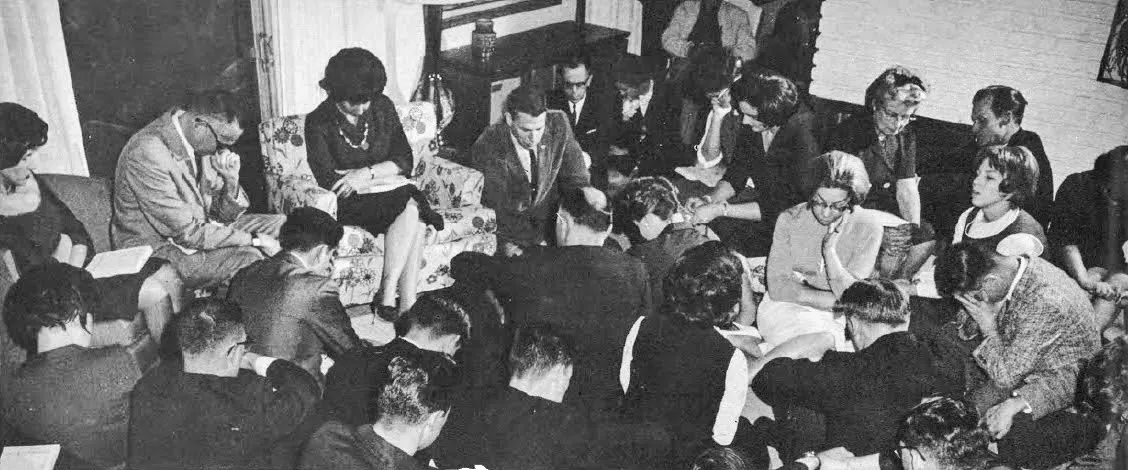
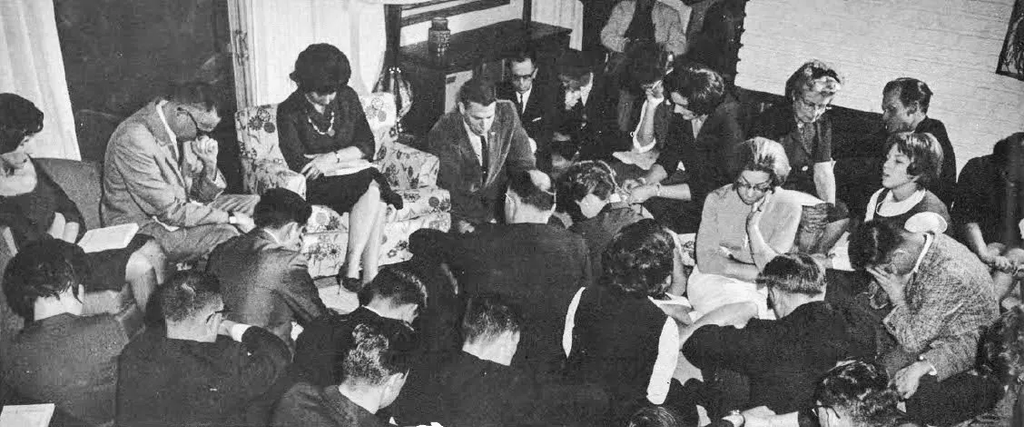
At the prayer meeting, after coffee and Kratzig’s telling the group something about himself and “how he had received the power of the Holy Spirit” a number of years before, all began to pray. Kratzig began, in his heavy Texas drawl, to pray for Maguire in particular although not mentioning him by name: “Now, Lord, there’s one here who wants to be baptized with your Holy Spirit. Pour it on, Jesus, pour in on!” Receiving this at first with a tolerant skepticism, Maguire began to grow increasingly irritated, even muttering to Bennett seated beside him on a couch that this was silly and that he wished Kratzig would shut up.
Suddenly, as Maguire recalls it, he found himself making a zzz-sound with his mouth.
I thought, “How silly. This must be imagination.” A second time, zzz. And then a third time,
I realized that this zzz wanted to come on coming. So, it being easier to let it do that, I let it go on coming and I realized that the Spirit really had hit me because then I began pouring out in tongues for quite a long time ….
After forty minutes of this I went home to my living room. I remember there was a big picture of Jesus there and, I remember standing under it and sort of praising Him. I’ve always loved music, loved hymns, and there’s one hymn I’ve always loved which goes: ‘Weak is the effort of my heart and cold my warmest thought, but when I see Thee as Thou art I’ll praise Thee as I ought.’ But I never thought that’d be possible until another life, that idea of praising God as I ought. But I suddenly found that I had the words to praise Him in this way and I found that was a tremendous sort of release, a tremendous elation.The elation just lasted about two hours and then the next morning I felt like I’d been through a wringer, you know, … an awful sort of letdown. I found I could still speak in tongues. It didn’t seem to mean very much. But then, as time went on, I began to find that little things were different, that my life had changed. There was a definite new dimension in it as in fellowship, as in expecting the kind of things that God would do, etc.3
Many of these experiences are prefaced by the clergy discussing how dreary their day to day existence was in the parish. They sound like they have hit the wall of burnout and are tired, even though many of their parishes in that vanished world were thriving. They were searching for something, some way out of tedium. Most, if not all, were investigating the baptism of the Spirit beforehand and were primed to receive the experience.
The root origin of charismatic Episcopalianism ultimately traces back, in my view, to Agnes Sanford, whom I will address next.
Leave a Reply