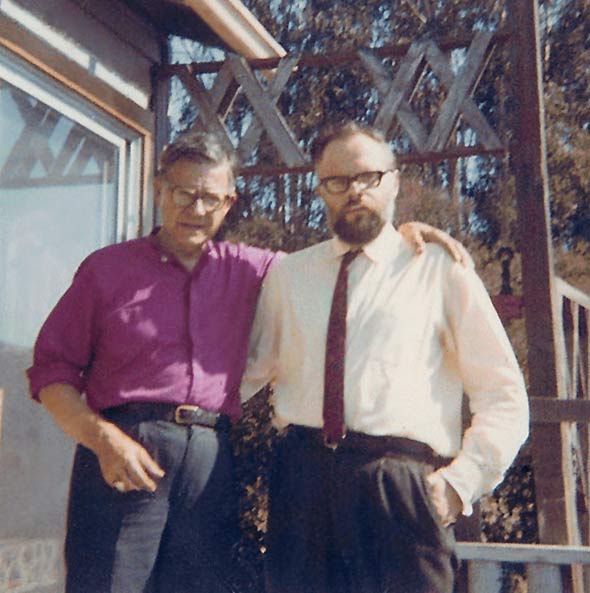
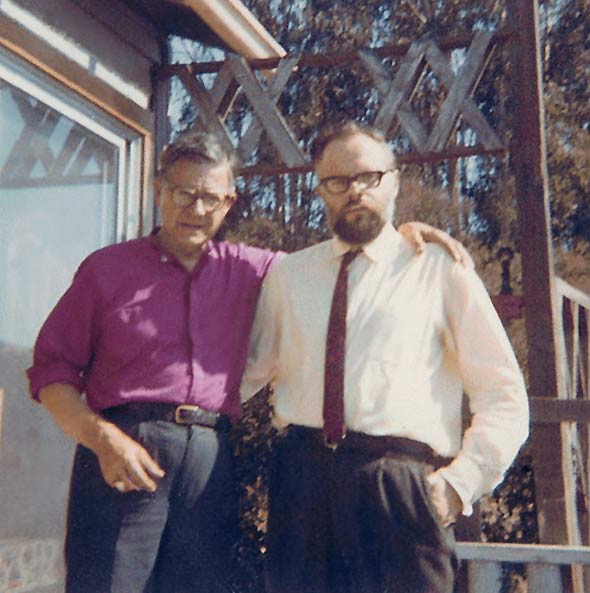
Bishop Pike was not a fan of the nascent neo-Pentecostalism in the Episcopal Church. He put together a commission to study speaking in tongues specifically. The commission struggled to even understand what they were supposed to be studying. As they put it:
Bishop Pike constituted this Commission as a study group to report to him on the nature and present status in the Church of glossolalia, and to make recommendations to assist him in setting diocesan policy on the subject.
This assignment has proven general indeed, for we have spent considerable time simply in defining and clarifying what we are to study and report on. We have felt hesitant to come to many conclusions. In the first place, the core of the problem lies in the relationship of the Holy Spirit to the ability to speak “in tongues”, and here we can state no decision as finally authoritative. The most we can do is to suggest outer limits beyond which churchmen should move with great caution or not at all. In the second place, we do not pretend to have undertaken a scientific study of glossolalia even as a human phenomenon and realize that conclusions would require this. In the third place, those who speak in tongues are agreed that this action in itself is far less important than what they assert it signifies; namely, the conscious reception of the Holy Spirit and His continued activity in a person’s life. A study which does not emphasize the larger question of the nature of all the gifts of the Spirit and their place in Christian life can only be preliminary and, we hope, clarifying.1
Reading this I sense that these respectable middle class professionals were having trouble getting their minds around people similar to them suddenly feeling energy tingling up and down their bodies and bursting out into things like “ashenda pakuyin nasutilimini limindiya!”2 Their report expressed humility about just what conclusions they could come to, saying “This Report has been largely descriptive, as befits a preliminary one…We stress that the reaction of others to the Report…may well correct what is here said either by correction, addition, or omission.”
They described what the charismatics were claiming in these Episcopal churches, namely that there were three types of tongues: Sign tongues, tongues used in private prayer, and tongues “for use with the gift of Interpretation in assembly.” They noted that Biblical literalism was prominent within the charismatic Episcopalians and thought that the clergy had failed to “share the outlook and fruits of Biblical Criticism with them in our use of Scripture.”
The commission warned against subjectivism: “It is always a mistake to confuse a feeling of God’s presence with His presence…” They warned both tongues-speakers and those who looked down on them against self-righteousness. All in all, their report was balanced and tentative, despite Rev. Ashey’s accusations of bias.
Bishop Pike issued the report with a Pastoral Letter from him attached, and his letter was not as charitable towards the charismatics as the report had been. He famously called the Pentecostal strain within the Episcopal Church a heresy in embryo and gave the following reasons:
- The emphasis upon the crucial character of the experience of “Spirit baptism” seems to minimize or neglect the Church’s conviction, as expressed through the Book of Common Prayer, as to the real action of the Holy Spirit in Baptism, Confirmation and the Eucharist.
- The heavily subjective emphasis upon a private personal relationship with “Jesus” (sometimes repetitively used almost as an incantation, apparently overlooking our Lord’s injunction against “vain repetitions”, which injunction would seem to apply to the use of His own holy Name), while it presents part of the truth, tends to the neglect of the full Christology of the Catholic Faith: the assertion in objective terms of Jesus Christ as God and man, crucified for our justification, risen and reigning over the Kingdom of God.
- And the strong emphasis on the indwelling of the Holy Spirit in a highly individualized way in a given moment of time, while reminding us of the importance of personal appropriation of the gifts of the Holy Spirit, would seem to minimize the underlying premise of our sacramental theology, namely, that the individual is once for all grafted in the Body of Christ, the Church, which is already indwelt by the Holy Spirit.
- The laying on of hands by presbyters and/or laymen, in connection with this experience or with the inducing of speaking with tongues, raises questions as to what ministers of Christ (also including the lay ministry) are authorized under our polity to confer the Holy Spirit in various sacraments and rites.
- The use of tongues in public services would seem to run counter to the Anglican tradition in favor of the use of the vernacular in worship, as expressed in the XXIVth Article of Religion, which is entitled “Of Speaking in the Congregation in such a Tongue as the people understandeth”. And it is in connection with glossolalia that St. Paul asks, how can people say “Amen” to what they don’t understand? (1 Cor 14:16).
As James T. Connelly recounts:
On the Third Sunday after Easter, May 5, 1963, Bishop Pike caused to be read at all morning services in all the 127 churches of his diocese a pastoral letter from him on speaking in tongues…3
Six times in the next twelve days the San Francisco Chronicle gave front-page coverage to “the ‘tongues’ dispute.” Pike was said to be “wrestling with the glossolalia underground,” and the Chronicle story of Friday, May 10, was accompanied by a photo of Attorney Philip Adams, the bishop’s observer at a parish prayer meeting, trying to shield his face from the photographer by hiding behind a prayer book. A week after the bishop’s letter was read in all ·the churches of his diocese, Jean Stone came to San Francisco to speak on the charismatic movement in an Assembly of God church, and the Chronicle printed a picture of Mrs. Stone, smiling, with the caption “spreading the word” opposite a photo of Pike, scowling, with the caption “fighting the trend.” On May 17, the Chronicle noted in a page-two story that the Reverend Tod Ewald,4 a priest in the diocese who had been promoting glossolalia in his parish, had told his prayer meeting not to speak in tongues.
Bishop Pike issued the following “Godly Admonitions”:
- The clergy shall exert no pressure in any form upon any person to induce the use of glossolalia.
- Laying on of hands shall not be administered by a layman, nor by a priest or deacon except in connection with the Prayer Book Office of the Unction of the Sick. (In connection with the blessing of children who, at the Holy Eucharist, come to the altar rail with their parents, while laying on of hands may not be used, a blessing in the form of the sign of the cross or outstretched hand may continue to be given).
- Exorcism of those presumed to be possessed may be performed or attempted by the clergy or laity only with the explicit authorization of the Ordinary, which permission shall only be granted when the Bishop, aided by professional advisors in this field, has determined that there is adequate psychiatric collaboration in the process.
- The clergy shall not speak in tongues as the Bishop lays on hands in Confirmation. Nor shall communicants be presented for “reaffirmation of confirmation vows”, with which such tongue speaking has also been associated. (This prohibition does not bar the fairly infrequent practice of “receiving back” into our Church a person who had left it to enter another religious body.)
The irony of all this is that as Pike’s personal life disintegrated he later ventured into all kinds of heterodox and evil practices himself, before and after his resignation. He could have taught the ACNA a thing or two about scandals:
Pike slept with various women during his second marriage, even installing a private line through which they could phone him. The most sensational episode came when Maren Bergrud committed suicide after a three-year relationship during which he had paid many of her bills with his bishop’s discretionary funds. As she was dying, she told him she had taken 55 sleeping pills. He rushed her to her own nearby apartment, called a doctor, who could not save her, and removed the part of her suicide note addressed to himself, later giving it to his third wife. This read in part: “(a) I am unlovable and (b) you are unloving… Maren.”
The bishop’s elder son, James A. Pike Jr., committed suicide at 20, apparently in unhappiness at being a homosexual. Stringfellow and Towne state: “Jim Jr. did talk with his father on at least one occasion … about his fears that he might be homosexual. Bishop Pike would later feel that he hadn’t been much help.” They report that Pike himself had had one “homosexual experience while he was a lonely law student at Yale … He hadn’t found the experience unpleasant or distasteful. ‘It was just that nothing seemed to fit together the way it should,’ he said.”
The authors examine Pike’s many efforts to talk with the dead (notably Jim Jr.) in seances, and suggest that the mediums he used probably learned in advance almost all of the obscure information that so impressed the bishop. They also note that since he and Diane agreed on the survival of the soul, they cut the words “till death do us part” from their marriage ceremony.5
Bishop Pike shifted his beliefs quickly throughout his life and particularly in the 1960s. One of the fascinating things about Pike is that he became friends with science fiction author Philip K. Dick and officiated Dick’s third wedding. After Pike died, Dick wrote a novel called The Transmigration of Timothy Archer that was based on Pike. In that book, Dick has Timothy Archer (the stand in for Pike) mention speaking in tongues:
Speaking in tongues did not impress him. He had seen a lot of it in his years in the Episcopal Church and it struck him as autosuggestion and dementia. Further, a scrupulous reading of Acts disclosed that at Pentecost when the Holy Ghost descended on the disciples, giving them “the gift of speech,” they had spoken in foreign languages which people nearby had understood. This is not glossolalia as the term is now used; this is xenoglossy.
“The so-called ‘gift of speech,’” the bishop said cheerfully, “reverses the unity of language lost when the Tower of Babel was attempted; that is, its construction was attempted. When the day comes that someone in my congregation gets up and talks Walloon, well, that day I will believe that the Holy Ghost exists. I’m not sure he ever existed. The apostolic conception of the Holy Spirit is based on the Hebrew ruah, the spirit of God. For one thing, this spirit is female, not male. She speaks concerning the Messianic expectation. Christianity appropriated the notion from Judaism and when Christianity had converted a sufficient number of pagans—Gentiles, if you will—it abandoned the concept, since it was only meaningful to the Jews anyhow. To the Greek converts it made no sense whatsoever, although Socrates declared that he had an inner voice or daemon that guided him . . . a tutelary spirit, not to be confused with the English word ‘demon,’ which of course refers to an indubitably evil spirit.
I believe this accurately reflects what Bishop Pike would have thought at that time. However, by 1967 Pike had shifted. He published a book in 1967 called If This Be Heresy where he addressed glossolalia.
In glossolalia, or speaking with tongues, there emerges through the individual’s unconscious mind, but apparently not from it, languages which have not been part of the experience or learning process of the speaker. There have been reported instances of speaking in known languages (either in their modern form or in a more archaic form) which are unknown to the speaker but understood by a listener who is competent in the given language. More commonly, that which is uttered though not an identifiable language has a “shape” which listening philologists have seen as justifying the conclusion that what is actually a language is being spoken. In short, glossolalia is not just babbling.
Associated with glossolalia is a correlative phenomenon: the “interpretation of tongues” by persons who appear to be thus specially gifted. The “translations” of such an interpreter often are expressed in a way which is quite foreign to his customary mode of expression. Furthermore, what is reported as the meaning generally corresponds in content to the categories of discourse into which the speaker senses that his words fall. And, finally, with all the differences in personality, acculturation, education, environment, and location, two or three generic themes serve to classify most of what is thought, both by speakers in tongues and interpreters of tongues, to be the content of the words: adoration, thanksgiving, and joy. For that reason the most readily available literary analogues are those Biblical Psalms which fall in these categories and psalms which have more recently come to light, namely, the Songs of Thanksgiving in the Dead Sea Scrolls.
Tongue-speakers who are Christians attribute the experience to the direct action of the Holy Spirit, often referring to their initial experience of glossolalia as “the Baptism of the Holy Spirit” or “the Second Baptism.” Further, usually they regard the experience as verifying conventional Christology, a literal eschatology, and a fundamental biblicism. But, quite apart from the soundness or unsoundness of these doctrinal positions as judged by other norms, the assumption of their truth on a basis of the fact of speaking in tongues is a case of over-belief. For the phenomenon of glossolalia has displayed itself all through history in quite diverse cultures and among people of quite diverse religious convictions.
Students of the subject who have sought to be objective, that is, open to accepting the reality of phenomena and, at the same time, wary of over-belief and inquisitive as to the psychological dynamics involved in the process, have suggested as plausible a linkage to one or both of two other psychological categories. One is extrasensory perception: the subject’s unconscious mind may be receiving what projects itself into speech from the unconscious or conscious mind of another person knowing the given language. But this explanation has its limitations. First, the speaking of known languages is the least common version of the phenomenon. Moreover, if it is assumed that the human transmitting station is a member of some remote and unknown tribe, while it can be granted that geographical distance has not proven a barrier to the functioning of telepathy, nevertheless this interpretation of cause-and-effect would involve an exceptionally selective instance of ESP. Finally, whether in the rarer instances of speaking in known languages or in the more common instances of utterances in unknown tongues, lacking still would be an hypothesis to explain the content of what is spoken is usually limited (apart from instances of “prophecy”) to praise, thanks, and exultation.
Whatever destination his evolving views took him to, this 1963 pushback against charismatics did not work. It either drove them to other churches or was ignored. A mere nine years later the Archbishop of Canterbury himself was asked:
What do you think of the Pentecostal movement — speaking in tongues?
“I believe it is a genuine sign of the presence of the Holy Spirit in the church. I am encouraged by the fact that in the Church of England those who value glossalalia also value the sacraments. We need not encourage division by fearing it.”6
Pike won the battle and lost the war.
- McDonnell, Kilian, editor. Presence, Power, Praise: Documents on the Charismatic Renewal. Vol. 1: Continental, National, and Regional Documents, Numbers 1 to 37, 1960–1974, Liturgical Press, 1980. Internet Archive, archive.org/details/presencepowerpra0001unse/page/72/mode/2up. ↩︎
- See Samarin’s Tongues of Men and Angels. ↩︎
- Connelly, James T. Neo-Pentecostalism: The Charismatic Revival in the Mainline Protestant and Roman Catholic Churches in the United States, 1960–1971. 1977. The University of Chicago, PhD dissertation. ↩︎
- “Rector of an Episcopal parish in Corte Madera which was attracting parishioners from all over the Bay Area due to its tongues-speaking services, Rev. Tod Ewald was a participant in the newly emergent charismatic revival. Pauline Phillips had found out about the church and in January, 1963, Miss Kim attended a prayer meeting. A week later, she attended again, shared some spiritual experiences, and met Rev. Ewald. Invited to speak at the next pentecostal meeting, she and Gordon Ross offered their testimonies. While the response of the audience was encouraging, even more propitious was Rev. Ewald’s reaction.” Mickler, Michael L. “Chapter Two: To The Bay Area: 1960–63.” A History of the Unification Church in America, 1959–74: Emergence of a National Movement, Tparents.org. Accessed 23 Sept. 2026.
Ewald was later the president of the Episcopal Charismatic Fellowship.
↩︎ - “Religion: Nothing Hidden.” TIME, 28 June 1976. ↩︎
- “Ramsey Comes Up with Answers To Some Current Questions.” The Witness, vol. 57, no. 3, 1 Feb. 1972. ↩︎
Leave a Reply