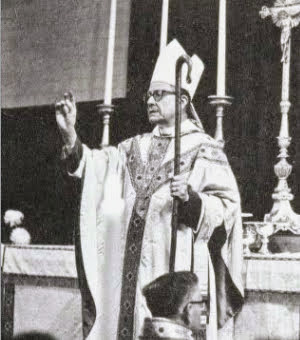
When Bishop Pike was against heresy
President Kennedy was alive. The Beatles had not landed on American shores. Vietnam was not the all-consuming maw that it would become. It was Spring 1963 in California and Bishop James A. Pike issued a Pastoral Letter to the Diocese of California warning that “…the imbalances and overemphasis of this other system of thought and practice presents the Church with heresy in embryo.” The system of thought he referred to was Pentecostalism, which was invading the Episcopal Church in the late 50s and early 60s.
Bishop James A. Pike is thought of in our circles as one of the paragons of collapse within the Episcopal Church. He became a heretic and the church could not even muster the strength to do anything about it. But at this point in the timeline he was a strong defender of orthodoxy against the emerging speaking in tongues phenomenon. This was the age of Barth, Tillich, and Niebuhr and Pike wrote books that defended what Time magazine called “smooth orthodoxy” of the Episcopal mainstream.1 His diocese happened to be one of the major centers for the emerging charismatic renewal, at that time referred to as neo-Pentecostalism.
The obvious ground zero of the charismatic movement was Dennis Bennett’s parish in Van Nuys, but Bennett had quickly resigned and moved to Seattle by the early 1960s. The movement was spreading like a wildfire however. James T. Connelly traces some of the developments. In October 1961 the reverends Tod Ewald and John P. Ashey (the father of current ACNA bishop Phil Ashey) went to a Camps Farthest Out conference in Riverside, California. Camps Farthest Out probably deserves its own post as an incubator of the charismatic movement, but the thumbnail sketch is that it is an ecumenical Christian retreat and prayer movement founded in 1930 by Glenn Clark, an author, professor of English, and athletic coach at Macalester College in St. Paul, Minnesota.2 This particular conference was “a week-long seminar on the healing-ministry led by Mrs. Agnes Sanford.”
Ewald’s interest in glossolalia stemmed from his having heard Mrs. Sanford and Dr. William Reed speak in tongues in prayer meetings held in conjunction with healing services that they were conducting, and he had come to the Riverside C.F.O. in the fall of 1961 with the expectation of meeting someone who would lead him into the experience.3
Two key women from the Blessed Trinity Society, another key link in the charismatic chain, were at the conference: Jean Stone and Joan Baker. Rev. Ewald “wanted to hear about the baptism of the Spirit” so one of Jean Stone’s friends took he and Ashey to her hotel room where they sat on the floor due to the amount of people there. Stone arrived to lead a prayer meeting. She told those assembled about the experience in Van Nuys and “the wonderful life His coming opens up for the individual.”
Stone laid her hands on Ewal “and asked God to fill him with the Holy Spirit. He began to speak in tongues and to laugh. It was the most infectious and the most joyous laughter I had ever heard.”4 It seems that Ashey was also baptized in the Spirit at this time. Jean Stone’s book focuses on Ewald:
Tod became a bomb. He had been baptized in the Spirit in October or November. He usually threw a Christmas party for the parish that cost him $500 in booze and was the talk of the town. As the time drew near someone asked him, “What about our party this year?” He said, “We’re different now. We don’t do things like that anymore.” He was so different that the entire diocese was amazed. Where he had previously been a very spiky Anglo-Catholic, suddenly Baptists, Presbyterians and others were attending his church and he even had altar calls. Don’t get the idea his churchmanship changed. This was one of the extraordinary things about him. After I had attended church there one time with all of the attendant “bells and smells,” Tod asked me how I liked the service. I hedged, “Could you get any more high church?” He quickly retorted, “You tell me how and I’ll do it!”5
Connelly relates that the tongues speaking spread rapidly in their parishes:
When Ashey and Ewald returned to their parishes after the C.F.O. conference in southern California, they began somewhat cautiously at first, to mention their experience to their parishioners, and before many weeks had passed there were prayer meetings in both parishes where participants spoke in tongues and newcomers were led into the experience of a baptism in the Spirit.
Bishop Pike’s commission describes what went on in the two parishes, first Ashey’s San Leandro All Saints parish:
… a program has developed over a period of about a year where initially some lay people and the rector met once weekly in the Rectory for prayer, study, and fellowship. A variety of the gifts of the Holy Spirit are reported as having been experienced from time to time, including, of course, glossolalia. Most of those involved used tongues as part of their devotional life day by day. An active healing ministry featured this group’s activity as well as prayers and hymns of praise and adoration both liturgical and nonliturgical. No one was allowed to speak in tongues (except inaudibly) unless another felt moved to speak in interpretation.
Recently, the group’s size and the feeling that the parish as a whole might resent “private” meetings of this sort led to the establishment of weekly programs in the parish church. These programs feature instruction on some aspect of the Christian faith followed by a social period over coffee. A service follows of an informal nature with hymn singing, psalm reading, testimony by individuals as they feel moved as to the meaning of Christ in their life and extemporary prayer shared by all as they feel moved. At the conclusion of the service, those who wish to remain form small prayer groups for both study and prayer with the manifestation of such gifts of the Spirit as tongues. At the conclusion of the evening individuals as they wish return to the Church for Unction, or for prayer for the “quickening” of the power of the Spirit, or for a Blessing.6
Rev. Ewald pastored Holy Innocents in Corte Madera and the report describes how services functioned there. The non-liturgical services in particular are fascinating and sound like Calvary Chapel or the Vineyard much later.
In this parish there is a continuing ministry through small groups called together from time to time by the Rector, but here, too, the focus of the parish program is in a weekly public service of healing and intercession at which he is the officiant. Anyone in or out of his parish is encouraged to pray for the reception of the Holy Spirit into their life as this is represented by the experience of glossolalia. These services are attended by people of different denominational backgrounds who in many cases come from a considerable distance.
The services are emphasized as non-liturgical. The rector, for example, wears no special vestments, but simply his street garb with clerical collar. The service typically includes most or all of the following: familiar hymns; a Scripture reading with lay interpretation as well as clerical; psalm recitation; intercessions in litany form both for the ill and distressed and for the diocese and the church at large; informal testimonies of witness by members of the congregation as they feel moved; “praising the Lord, each in his own way” (some in tongues); a ceremony of healing at the altar rail where priest and laymen (who previously have “commissioned” one another by laying on of hands accompanied sometimes by glossolalia) lay hands on those who desire it; the bringing of a message in tongues with interpretation; and prayer with laying on of hands for the reception of the Holy Spirit with glossolalia.
In November, 1962, this parish sponsored a “Christian Advance” mission in cooperation with clergy and congregations of other denominations. It was given publicity in principal San Francisco newspapers. Its stated point is to bring people to a “baptism in the Holy Spirit,” phraseology typical of the movement which we are studying. It might be noted that in the publicity the movement was described as “the greatest revival in the Church since the Reformation.
By the Spring of 1963 Pike’s commission “estimated that at least twelve clergy and more than two hundred laity were actively involved” in the Diocese of California. Rev. Ewald knew that Bishop Pike was not happy about the outbreak of tongues in his diocese and so he scheduled a meeting with him, probably in early 1962. Ewald took Jean Stone and a minister from another denomination with him to the meeting. As the non-Episcopalian minister spoke to Bishop Pike, Ewald “rocked back and forth praying, “Jesus. Jesus. Jesus.”7 Stone told Pike that the baptism of the Spirit produced more ecumenicity, something he was known to love. Stone recalls the end of the meeting:
During our talk the bishop had two cigarettes going at the same time and had set the rug on fire. While he was stamping out the fire, he set his pants afire and began beating on them. When we left he prayed that many would be filled with the Spirit through our ministry and gave us each an autographed copy of his new book, Beyond Anxiety. It seemed ironic.
At some point, with Pike’s permission, the famous Rev. Dennis Bennett spoke to Stanford students and 50 Episcopal priests. The priests were apparently “enthusiastic” about Bennett and his message, and Jean Stone says “a number of Stanford students entered into this dimension of the Spirit.” Pike’s assistant bishop G. Richard Millard was not happy about these events and complained bitterly and requested the bishop to put an immediate halt to glossolalia in the diocese of northern California” (Stone 55). This was the first key event that turned Pike against the charismatic faction. The second was a visit the Bishop paid to Tod Ewald’s parish for a confirmation service.
For one thing, Ewald had a habit of speaking softly in tongues while he moved about the altar during a service. He did it during the confirmation service and Pike became angry at him for doing it. Moreover, when Bishop Pike arrived for the service he had a very severe cold. Seeing this, Ewald took it upon himself to instigate public prayer for the bishop at the church, and the latter was further annoyed. Finally, after the confirmation service, Ewald suggested that those in the congregation who would like to “renew” their vows to follow Christ made at their confirmation come forward to the altar for a rededication. Bishop Pike obligingly laid hands on the many who flocked forward. But when some of these spoke in tongues as he did so, he was infuriated (Connelly 98).
Stone adds that Bishop Pike was still impressed with the congregation: “However, a friend of his told me later that he had confided in her, “But they really do have something. They prayed for my cold and I was healed.”
It has to be said that most of these early Episcopalian charismatics got excited about the Bible when they had their baptism experience. They generally seemed to have become more literal in their views of the Bible, to have taken up daily Bible reading, and to have fallen more in love with God, at least initially. This literalism was in opposition to the type of churchman that Bishop Pike was, which was concerned with intellectual trends, civil rights, and cutting edge discoveries from the Dead Sea Scrolls. The outlines of the future split that created the ACNA are there to be seen: Spirit-filled literalists and their adjacent camp versus the establishment who drifted on the tides of the day. Also, many of the clergy say that they used to drink, smoke, and take barbiturates and that after their baptism they stopped all that and fell back in love with God and the Bible. Contrast this with Pike who was an alcoholic, a serial adulterer, something of a narcissist, and was more in love with intellectual fads than the orthodoxy of the Episcopal Church.
Bishop Pike was alarmed enough by the rapid spread of the charismatic movement that like the Episcopal Diocese of Chicago before, he put together a Study Commission on Glossolalia. The commission was chaired by Canon David Forbes, Rev. John Ashey, Rev. Thomas Bogard, Canon Trevor Hoy, the Rev. Dr. Edward Hobbs, the Rev. Dr. Charles Whiston, Dr. John W. Perry, Dr. Richard M. Sutherland, and Mrs. John Buenz. This group had expertise on behavioral science, human behavior, Biblical studies, systematic theology, psychiatry, parapsychology, and in Ashey’s case with tongues speaking itself. Ashey had a problem with the composition of the commission:
In appointing a study committee the Bishop had, I think, pretty well predetermined what his course of action ought to be and he simply wanted to reinforce his own thinking. Therefore, in appointing members on the commission which consisted of several parish clergy, a semantist [sic], a psychologist, a theologian from our seminary in Berkeley, a former Roman Catholic theologian, and myself, he selected those who had had no encounter with or knowledge of, or willingness to explore firsthand the actual dynamic of what was going on in those two churches. The study commission therefore, conducted its affairs removed from the actual events themselves and I feel that my appointment was meant to be a gesture of the Bishop to give an image of ‘fair-ness’ to whatever findings might result.”8
Because this post is getting long, I will defer the commission’s findings to the next post.
- “Religion: A Life on the Brink.” Time, 11 Sept. 1969. Accessed 28 Sept. 2026. ↩︎
- See https://www.cfoclassicslibrary.org/articles/glenn-clarks-vision-for-the-camps-farthest-out/ for details. ↩︎
- Connelly, page 94-95. ↩︎
- Cited in Connelly, page 93-94. ↩︎
- Willans, Jean Stone. The Acts of the Green Apples. Society of Stephen, 1995. Internet Archive. ↩︎
- Diocese of California, Division of Pastoral Services, Study Commission on Glossolalia, “Preliminary Report,” submitted to the Bishop, May 2, 1963, released May 14, 1963. Cited by Connelly, pages 95-96. ↩︎
- Willians, page 54. ↩︎
- Connelly, page 111. ↩︎
Leave a Reply