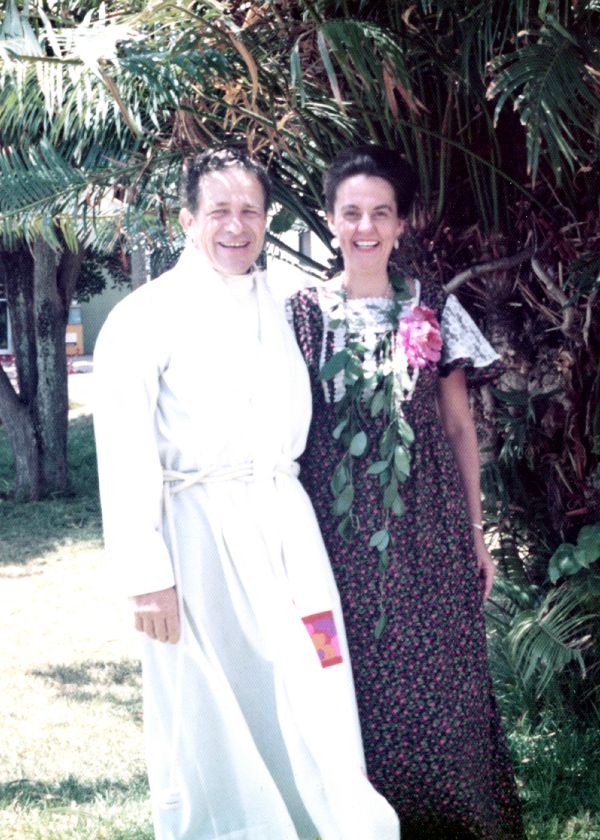
One account of what occurred at Church of the Resurrection under Rev. Richard Winkler comes from Leanne Payne who was there as a young student in the early 1960’s. Payne went on to propagate healing prayer, writing books and taking up the torch from Agnes Sanford. Payne was influential at Wheaton and later established Pastoral Care Ministries to further her theology and practice. In 1964 she joined the prayer circle of Father Winkler. She describes the prayer circle:
Of all the good that came to me with the need to seek a new church in Wheaton, the greatest blessing was getting to know and work with Rev. Richard Winkler, Rector of Trinity Episcopal Church. Fr. Winkler provided for his people an ongoing place of Eucharistic worship and healing such as I have not seen equaled before or since. It grew the people of God who participated with him in prayer for healing of the sick in body, mind, or spirit, and its influence grew the church nationally and internationally. Being so graciously accepted and received into Fr. Winkler’s weekly prayer circle meant that, although I was living and working in a religious setting untouched by the charismatic renewal, I was an active participant in one of the most vital renewal groups anyone could ever hope to discover. In and through this fellowship, the Holy Spirit was free to move quietly and profoundly through God’s servants to heal the sick in mind and body.
Payne describes an environment of miracles and although she does not use the term “three streams” she certainly describes what it would come to be known as:
This prayer group was a continuation of the book of Acts, replete with miracles, such as our small prayer group back home in Little Rock had known. In contrast to the latter, however, there was a crucially important difference that more nearly mirrored the early church’s example. By that I mean it was the first time I had experienced the charisms in operation when fully integrated with the liturgy of the Word and Sacraments. Liturgy, both formal and informal, provided the means whereby rare, wise, and humble clergy and elders passed on the discipline, wisdom, and knowledge of ages past in regard to the church’s ministry of laying on of hands; anointings; prayer for emotional, spiritual, and physical healing; and deliverance (including full exorcism) from sin and the demonic in a life. Most in the renewal of that time had to struggle along not only without this kind of leadership and direction but with the disapproval of their respective church bodies.
You can see hints of future problems if she is correct that the clergy who were humble and charismatic were “rare.” She provides more detail about what the prayer circle meetings looked like:
We were always too many for whatever room was available, so chairs had to go and most stood or sat on the floor. We were discreet about our meetings so as not to provoke the hostility of those who hated healing prayer and ministry to the sick. We came together, quite simply and informally, to pray for people, many of whom had come secretly, especially church or school officials from groups who would not approve. With great joy we would sing, laugh, give testimony, and read the Scripture. Then came the moment when what chairs we had were formed into a circle. The regulars sat down there and “agreed in prayer.” We would pray right around the circle, each speaking out in a tongue, an interpretation, a prophecy, a Scripture, a song. This is just like in the Scriptures. By the time we went around the circle, the Lord had given us the very wisdom we needed for the healing prayer to follow. We would know the theme—most wonderfully given—and receive the special faith for whatever was needed.
I participated in something like this at Christian school as a kid, so I have seen it in action. In my case it involved us closing our eyes in prayer and asking the Lord to give us a verse. We each had a verse given to us randomly and went around the room, merging them together into what the Lord was saying to us. I cannot recommend this as a practice but I think it must have descended from what was going on in this Chicago movement.
Payne shows that Winkler’s Chicago parish was connecting with the educated classes from all over, and includes Dennis Bennett in this list although he had connected with Winkler in 1960:
People, including well-known leaders (clergy, physicians, nurses, theologians, professors and teachers, authors, and lay leaders), traveled to Trinity Episcopal Church from the ends of the earth to visit, learn, and receive prayer for restoration and freedom from whatever chains bound them. Indeed, Fr. Winkler laid hands on, anointed, and prayed for countless numbers of priests to be baptized in the Holy Spirit, and they in turn ministered to others. One of them was the Reverend Dennis Bennett who took the ministry forward in wonderful ways—but especially through his book Nine O’Clock in the Morning and his ministry to orthodox priests.
This informal networking is a feature of church life that often flies under the radar, but was crucial to establishing the precursors to both ACNA and GAFCON. She notes Winkler’s connections to other high-profile Christians of that day, “Through Fr. Winkler I came to know of and meet many others gifted in the time-honored Anglican tradition of healing prayer, including Catherine Marshall, Agnes Sanford, and R. A. Torrey III, missionary and founder of Jesus Abbey in Korea.”
Payne quotes from a letter she wrote home from those days and shows how tongues worked in Winkler’s circle:
Thursday night I attended the healing services at Trinity Episcopal and stayed for the prayer meeting later. The prayer meeting was over about 1 a.m. Friday! I guess there were about 45 persons there, all of whom had been filled with the Holy Spirit—and talk about sweet communion and fellowship! There were ministers of other faiths or rather denominations there and some of the finest people I have ever met. As the Spirit moved, there were tongues and interpretations, prayers, a beautiful song in tongues with accompanying interpretation and we just quietly worshipped and praised the Lord together. Then the Episcopal priest [Fr. Winkler] asked if anyone needed prayer. His wife mentioned that I desired the gift of tongues. He laid hands on my head, asked the Lord for this gift for me, admonished me to yield my tongue and my lips to the Holy Spirit, and then effortlessly and easily came a language I have never known. This done, he laid hands on my head and prayed again that I might interpret. This I did. WOW! All this was quietly, sweetly done. I may never again interpret (I certainly hope this is not the case) but interpretation seemed to be a matter of yielding to the Spirit with English forthcoming instead of another language. Every soul there did their own interpreting—first the message in tongues and then in every case the same soul received the interpretation. Talk about intercessory prayer for the saints—we prayed for about 180 souls by name. One of the things I didn’t mention was that after I had received the first language and interpretation, Fr. Winkler prayed for me again, asking for a completely different language to come forth. He wanted to bring me into freedom in the gift. I have followed this course through the years when praying with folk, for although many have the gift, it can be bound within them. Furthermore, they often yield to it in such a way that it comes out strangely garbled. These are beautiful languages that, when yielded to properly, are to be fully enunciated.
One unfortunate commonality amongst charismatics that has bled into leadership all over the place is to attribute opposition as an attack of Satan. While this could be true, it is routinely used to shut down criticism and scare off the people in the pews from hearing about abuses or other views. In Payne’s case, she sees the opposition that erupted against Fr. Winkler as spiritual warfare. She writes, “Those who served on the prayer team were deeply aware of this warfare, as was Fr. Winkler. He was to suffer a national pillorying that was a type of crucifixion for a man such as he, one with the Spirit’s charisms of love, compassion, and gentleness toward his fellow man that were far beyond the ordinary.” While I don’t grasp all the details of what happened, there was a story that drew national attention to Rev. Winkler; it appeared in the May 16, 1964 issues of The Saturday Evening Post, which at that time in the media lifecycle was a major publication.1
The amazing thing about the article by John McCandlish Phillips is that it doesn’t mention Winkler in its text at all, but he appears in a picture with the caption, “In service at Trinity Episcopal Church in Wheaton, ill., Rector Richard Winkler lays on hands to transit the experience that inspires glossolalia.” Phillips did some great reporting, driving and flying across the country to document the charismatic movement that was bursting through the walls of the mainline churches in the revolutionary 1960s. Episcopalians feature heavily in the article, including the Very Rev. John J. Weaver, the dean of Detroit’s Episcopal Cathedral of St. Paul–someone whose biography will be worth taking a look at later. Phillips describes this Detroit cathedral as a center for the baptism of the Holy Spirit, writing:
The Very Rev. John J. Weaver, the tall, white-haired dean of Detroit’s Episcopal Cathedral of St. Paul, puts it even more forcefully. “The disease today is nihilism—nothingness,” he says. “And I don’t mean philosophical nihilism: I mean lived nihilism, the kind you find in hospital beds, in the office. The problem today is lack of power, spirit. The bones are dry and dead. We need a new strengthening of the spirit. I think the reason we are seeing speaking in tongues today is that the world is so fragmented and torn, and in the midst of all this loneliness and fragmentation the Christian needs a fresh indwelling of the Holy Spirit.
“I don’t think the Christians were singing Quo Vadis in the Colosseum: I think they were praising the Lord in tongues. There is no essential difference between ‘the man in the lonely crowd’ today and the lonely man who was thrown to the lions except that different kinds of lions are eating him up. Today’s man is fighting invisible animals. The Lord edified the other man by giving him the gift of tongues.
“Ministers from virtually every denomination have received the gift of the Holy Spirit in our cathedral,” he added. “I don’t know where they come from, how they get here, but they come.”
The article also mentions “five Episcopal rectors in the meeting at one time” at charismatic Presbyterian pastor James H. Brown’s United Presbyterian Church in Upper Octoraro, PA. The article also mentions Holy Innocents Episcopal Church in Corte Madera:
It is a high-church parish, and inside the small building mobiles slowly twist and glide. Its rector, Rev. Tod W. Ewald, is a cordial, outspoken and rather authoritarian priest. Before he received the “infilling of the Holy Spirit,” Father Ewald had been regarded by other ministers in Corte Madera as dogmatically contemptuous of expressions of the faith that did not coincide with his own. “Now the walls have just crumbled down,” he said. “We’re all one in Christ. I could no more have said that two years ago than fly.
“We have 350 members, and one third of them have spoken in tongues at our altar, with beauty and wonder and reverence,” he said. “We received this Pentecostal experience at the altar rail by laying on of hands.” Parishioners from 20 to 70 who had received the experience told of estranged husbands and wives finding renewal of love, of atheist relatives suddenly reaching for God, of off-and-on churchgoers becoming twice-a-week attenders, of tranquility and a new effervescence. “You just bubble, bubble, bubble,” one man said.
As I said, the article does not mention Fr. Winkler in the body of the text, but his picture and his underground reputation now thrust him into an unwanted national spotlight. Leanne Payne says that the article, “…hit the newsstands with a story entirely unforeseen by us–one that would have enormous consequences for those of us involved in healing prayer.” Payne describes the now infamous picture of Fr. Winkler laying on hands and says, “One of the things causing our severest difficulties within the church was that this particular sacramental laying on of hands had nothing to do with glossolalia, and the priest pictured as receiving it was not part of the prayer group, nor was he sympathetic to it. But this was merely local: our difficulties didn’t stop there. Vitriolic reactions came toward us from far and near.”
James Thomas Connelly says that “Phillips had interviewed Winkler with respect to the healing ministry, and Winkler had understood that that would be the topic of the article. Phillips’ editors, however, had cut his material considerably and had chosen to emphasize the more sensational side of the charismatic renewal in the mainline Protestant churches in the United States, giving special attention to the experience of baptism in the Spirit and speaking in tongues.”2
Payne outlines the divisions that rocked the church:
Other pictures appeared with the article, none from our group. But because of the full-page photo with its mistaken caption, Fr. Winkler, a man who had never sought the spotlight, was suddenly in it. The persecution of him and of our prayer group that resulted from the Post article was scarcely believable. In those days many Christians did not look kindly on these kinds of healing ministries, and some were in our own congregation. In listening to God and praying as he was led, Fr. Winkler exercised a truly great gift of healing. The worldly pride in the church was such, however, that many people despised him for doing so. It was chilling to see folk who knew of a dying baby being restored, and yet who hated the ministry and the one who prayed for the infant. These people did not attend the healing Eucharistic liturgies and prayers and formed no part of the prayer group.
James Thomas Connelly says that some of Winkler’s own parishioners voiced misgivings about “the activities of Winkler and his prayer group” over this article.3
When the article appeared, the vestrymen and others at Trinity Church, Wheaton, began to be the butt of jokes from-friends and neighbors about strange goings-on in their parish. Eventually a complaint was made to Bishop Burrill by several members of the parish and the bishop met with Winkler, his Vestry and a Warden. In keeping with guidelines that the bishop had laid down in 1960, Winkler had been making quarterly reports to him on the activity of his group, and Bishop Burrill backed him in this controversy and wrote a letter to the parish asking that the contention being stirred up by some of the parishioners come to a halt. Shortly after this, Winkler decided to move the charismatic prayer meetings from the parish hall to the home of one of his parishioners.4
Leanne Payne adds:
After the Post article, the vitriolic hatred hurled at us from fellow Christians, who were outside the renewal, forced us underground. We had to meet more secretively than ever, even as the early Christians did in the catacombs. Taking a cue from them, we posted the sign of the fish to places where we would be meeting with others for healing prayer. The ones hardest hit were Fr. Winkler and our dear Helen Galloway. Fr. Winkler, not a young man, left the church in Wheaton in 1967, largely because of the division the ministry of healing caused. He and Dorothy moved to Hawaii where he pastored a small congregation on Maui.
Fr. Winkler closed out his ministry at Holy Innocents Episcopal Church in Lahaina.
- https://johnmphillips.org/articles/and-there-appeared-to-them-tongues-of-fire/ accessed 1 Sept 2026. ↩︎
- Neo-Pentecostalism: The Charismatic Revival in the Mainline Protestant and Roman Catholic Churches in the United States, 1960–1971, 69-70. ↩︎
- Ibid, p. 69. ↩︎
- Ibid, p. 70. ↩︎
Leave a Reply